Portrait of a Faith-Plumber
Dušica Popović
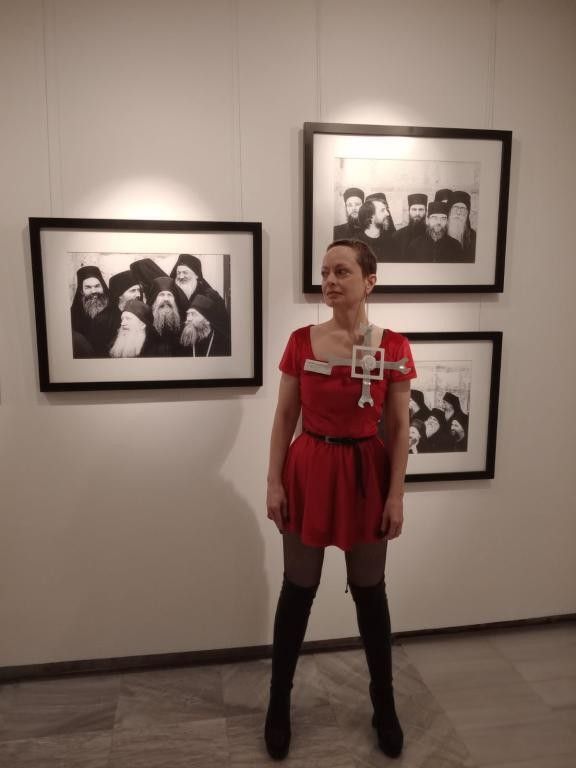 At the exhibition The Virgin’s Garden, MAA, 2026.
In Serbia, the past always runs ahead of its time.
— Ninus Nestorović
Technology is an exertion undertaken in order to save exertion.
— José Ortega y Gasset, Meditations on Technology
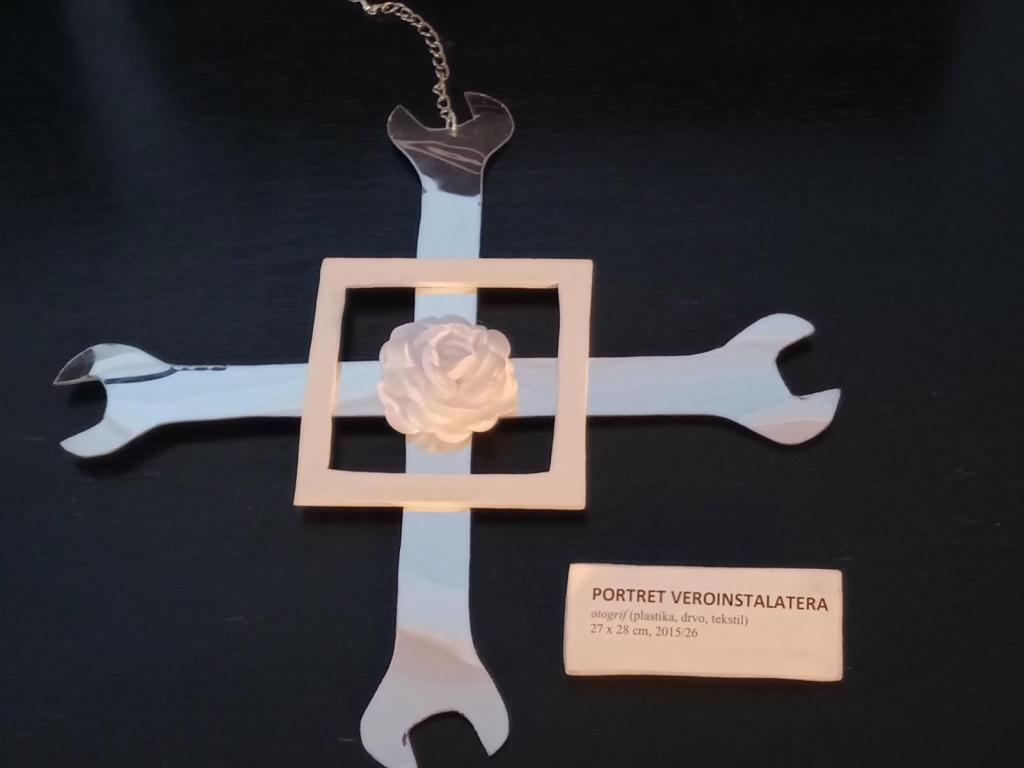
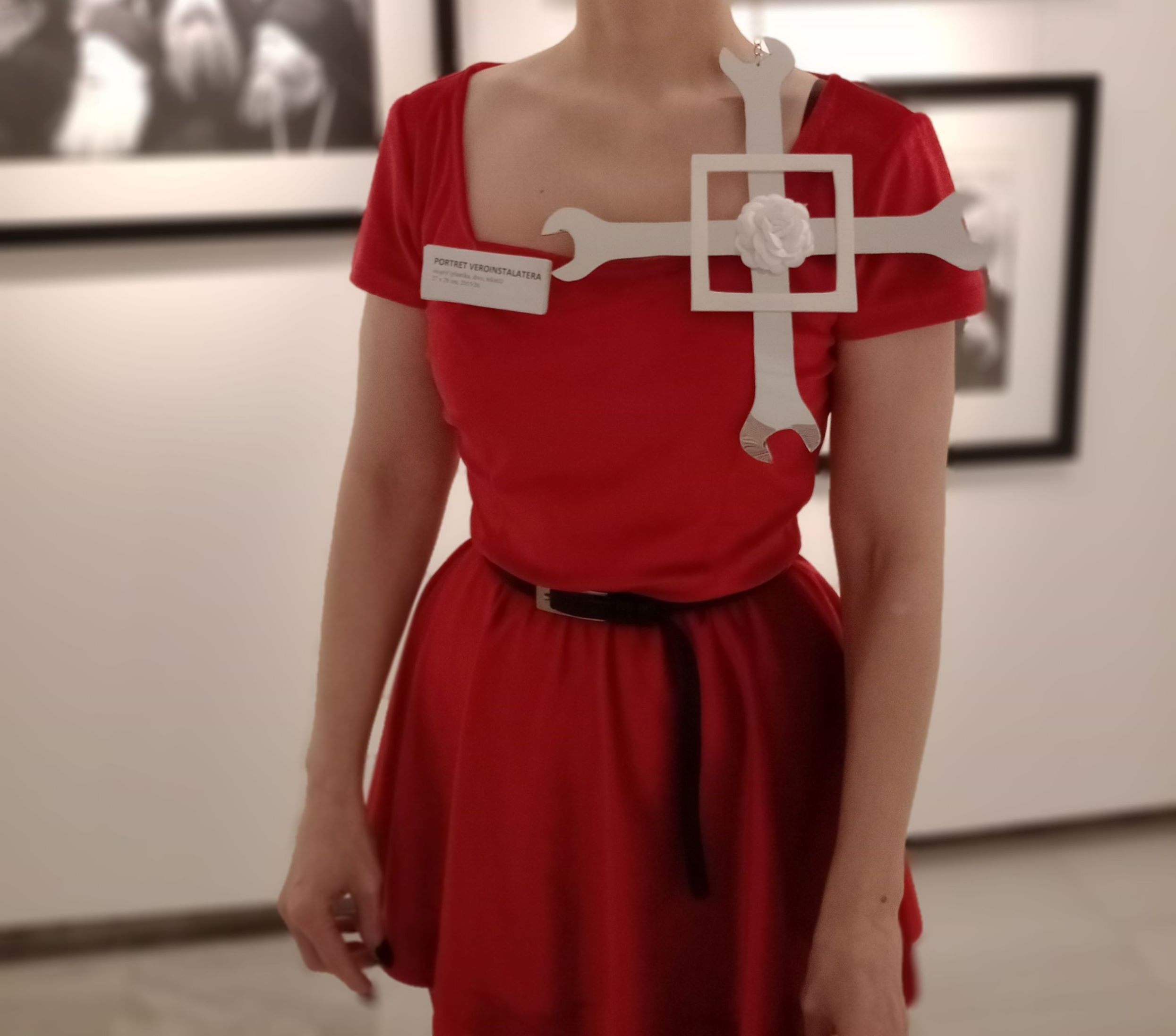
The recently restored otogriph[1] PORTRAIT OF A FAITH-PLUMBER from 2015 arrives from an apocryphal future.[2] The term “faith-plumber” (in the masculine form) is a portmanteau of the words “religious instructor” and “plumber,” designating a future species of religiously and scientifically (un)consecrated technicians or IT priests (say, from the Year of Our Lord 2226). Insisting on “spirituality,” they will continue manipulating the social fabric[3], not (only) through preaching but also through other, certainly more efficient technologies. They will be advanced techno-god moths who, like true moths devouring organic matter, will consume and destroy every free, organic thought left over from their past—that is, from our present. Hence, the section of the cross within the frame, adorned with a white camellia, evokes ethereality and spiritual purity, while the spikes of the cross shaped like pipe wrenches (“rough construction works”) remain, as always, outside the boundaries of the officially proclaimed image.
The connection between science and religion, incidentally, emerged already at the dawn of the modern age, in the sixteenth and seventeenth centuries. Yet at that time, one of the earliest advocates of modernity, experiment, and induction, Francis Bacon, in his New Organon, had to defend science by appealing to religion, claiming that “science aids in the redemption of man, since through it human beings may alleviate the consequences of punishment for original sin and even recover the pre-natural virtues they possessed before the Fall.”
Naturally, with the advance of the modern project and the Enlightenment, science—and with it the technology connected to it—lost the need for that sort of legitimation, enabling humanity to emancipate itself from religion and to rely on its own capacities in the pursuit of knowledge. This implied a more or less radical rejection of transcendence and a reliance on immanence. Yet in our own time there is once again a (debatable) rapprochement between scientific-technological and religious culture, though with the opposite emphasis: whereas scientific and technological research was once defended by invoking religious goals, today religion is often defended by invoking science (and technology), which allegedly actualizes religion itself (for example, there are claims that “quantum physics confirms the power of prayer”; although fasting originally signified contempt for gluttony—that is, sensuality in general—and the triumph of spirit over the body, nutrition science has now “proven” that fasting is beneficial to the health of the body; psychology “confirms” greater mental balance among believers, etc.). Such convictions are grounded in a failure to distinguish between science and technology, a confusion inherited from the socialist period. At that time, mere technologization (enabled by science) was naively equated with science itself, and science with modernization and emancipation. In the meantime, however, this has proven illusory: although science is by its nature emancipatory, insofar as it rests upon continuous self-questioning, technology as a skill, unless critically reflected upon, may serve any kind of (religious) dogma.
Thus, there exists an analogy between Christianity and an important aspect of contemporary technology: Christianity’s aversion toward materiality as such coincides with the dematerializing character of contemporary technology. More and more aspects of modern life are subject to dematerialization, from money to communication. One may therefore expect that technology will soon advance to such a degree that most people will possess no (permanent) objects whatsoever (without built-in self-recycling programs), which could amount to a paraphrase of the Christian vow of poverty. Likewise, if science and technology have already enabled the creation of a human being without sex through artificial insemination (“immaculate conception”), one may expect that they will one day enable the disappearance of the human being without death, through the replacement of all worn-out organs with previously preserved stem cells of one’s own (an earthly resurrection?!), and so forth. All of these are perhaps ways of “recovering the pre-natural virtues we possessed before the Fall.”
Still, it would seem that the similarity between, conditionally speaking, religion and science-technology appears as an epiphenomenon of the rapid development and complexity of artificial intelligence. Artificial intelligence will undoubtedly become increasingly autonomous, while the vast majority of people conditioned by it will not understand how it actually functions. Already today, this fact renders contemporary technology quasi-mystical, thereby making it complementary to the quasi-rationality of religion (as theology); technology as a new desacralized religion (of governance) becomes interchangeable with religion as an old sacralized technology (of governance). Within such a framework, people who do not belong to the new class of narrowly specialized IT priests may finally attain a stage of “new innocence” or “blessed” numbness, a kind of mental paralysis, since both faith and knowledge will become superfluous: people will have no reason to believe in religious postulates such as “eternal life,” because technology will literally embody them, yet neither will they be able to know how this is accomplished. And this newly emergent cultural profile of society could perhaps be called a kind of caring nothingness, a nothingness with a human face, illuminated by divine grace…
Notes:
[1] Otogriphism is an artistic movement whose theory and practice I have been developing for many years. This involves performing five different functions simultaneously, since I am the author, theorist, curator, exhibition space, and epigone of my own art. The name of the movement is a neologism composed of the words oto (Greek: ear) and griff (German: grip), which may literally be translated as “ear-grip.” The movement bears this name because it consists of objects—otogriphs—worn on the ears. Otogriphs contain aspects of sculpture (three-dimensionality); installation (heterodoxy of materials); jewelry and accessories (otogriphs are “blind,” or rather “clairvoyant,” passengers in the land of accessories); performance (otogriphs are concrete objects implying performativity—that is, time as a kind of “packaging” in which they are exhibited, though not as their constitutive element, as is the case in performance art); and relational art (relations are not the primary medium of otogriphs, but emerge as a kind of epiphenomenon or “contraindication” of the otogriphs themselves). Each otogriph (except for the epigones) is accompanied by a caption stating the title of the work, the name of the object, the material, the year of creation, and its dimensions. The caption is important because through it I carve out my own infinitesimal space between art and life, since I exhibit my works exclusively on myself…
[2] Certain otogriphs belong to a temporal dimension that I call the apocryphal future. I use this term by analogy with apocryphal writings (for example, Gnostic gospels and the like), which the Church does not recognize as canonical. Thus, the apocryphal future is not an “official,” “canonical” future such as the one predicted by various scientific institutes for future studies, which base their assumptions on certain empirical and statistical data. Instead, I announce/produce an “auxiliary” variant of the future, which is in fact a “requalified” present. It is a present possessing a surplus of material preventing it from collapsing into itself, into mere actuality, but not enough to reach an actual, “orthodox” future (or so I hope).
[3] One example is a statistical finding from 2019: as many as 78% of people in Serbia believed that a person who is not of the Orthodox faith cannot be of Serbian nationality. Unfortunately, this faith is most often nothing more than a clerical-nationalist strategy for the sacralization of cultural and political conservatism. Yet perhaps the unreflective insistence on obsolete—pardon, consecrated—discourses in the public sphere says less about the degree of indoctrination than the discreet traces of this ideology in unexpected places—even in unpretentious motivational articles about finding employment, seemingly devoid of any political or religious background:
“Meaning largely comes from ourselves, because the same job may be fulfilling to one person and frustrating to another. A job we today experience as a necessary obligation may over time become a source of growth, if we change our perspective. This is not always realistic; sometimes there are not many options, and one must be objective about that. But what depends on the individual is how much purpose they will ‘load into’ their work. Thus, if asked ‘What do you do?,’ three construction workers will give different answers. One will say: ‘I’m laying bricks’; another: ‘I’m building a building’; and the third: ‘I’m building a church.’”
In this article, the third option—the church (Orthodox, naturally)—is not treated as a mere religious institution but as a symbol of meaning as such (sic!).
The Seductive Emptiness of Form
Wilde’s incisive reflections on false social morality perhaps have an even more piercing effect today, in a contemporary society where the boundaries between lies and truths have become still more fragile and porous, and where the obsession with bodily beauty and youth is far more tragic
Bolet and Marie – cryptoqueer Norwegian photography pioneers
The photography exhibition Bolette Berg and Marie Høeg, organised by the Center for Queer Studies, was held at the European House from 15 to 19 December 2025.
Cruel Scenes from Everyday Life
The promised hot autumn has fully materialized in Belgrade’s galleries, bringing a multitude of exhibitions throughout October. Most of them present works by already established artists, shown alongside young talents whose careers are just beginning.