Roma Women Are Reduced to Street Activism
Ivana Perić
Jelena Savić is a Romani woman born in Belgrade. She belongs, as she says herself, to the generation of the 1980s that experienced the remnants of socialism, even though her existence, even in socialism, was marginal — on the very edges. For 20 years, Savić has been present under the username Usernameka on WordPress, the address of her blog. That’s how we first encountered her work. In addition to her blog, Savić writes poetry, always at the intersection of Roma, gender, working-class, and ecological themes. She plays with meanings, forms, and genres. She holds an MA in Philosophy from Central European University (CEU) in Budapest and a second MA in Adult Education from the Faculty of Philosophy in Belgrade. Her academic research focuses on intersectional issues of sexism, class, racism, and speciesism. She has been active in feminist circles since her student days, though, as she admits, with good reason, less so today. We meet Jelena in Belgrade on a warm evening, sipping overpriced beers, talking about all the ways in which life exacts its cost.
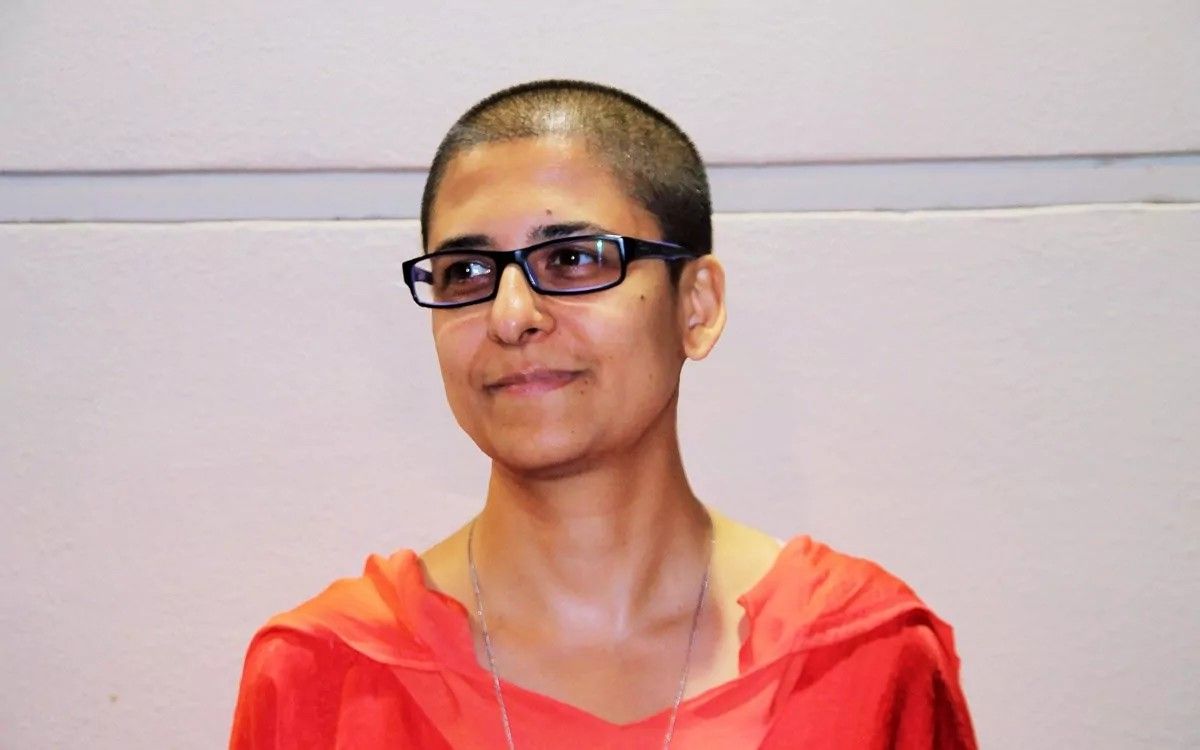 Photo by Ivana Perić
You’ve been blogging for 20 years. When you started, what drew you to language, to paper, to the keyboard?
I started writing back in high school — diaries, poems. Then I went to university and entered NGO circles, at AŽIN, where Dubravka Đurić, who teaches at the Faculty of Media and Communications, was active. She had this global perspective, knew world literature. She brought us so many things; it was the time of anti-war feminism. We were very engaged with postmodernism, philosophy, literary theory. It was wonderful, a formative period for my poetry. Back then, we put together AŽIN’s anthology Discursive Bodies of Poetry: Poetry and Autopoetics of a New Generation of Women Poets, which turned out to be significant in the history of Serbian literature. We also explored the politics of poetry — who gets to call themselves an artist, and from what position.
“Serbian feminism is predominantly non-Roma.”
Is that when you started your blog?
Yes. I started blogging because I really had nowhere else to write. Activist circles were very focused on anti-nationalism and feminism, but within that framework, there was no space to articulate a Romani identity or experience. Serbian feminism is predominantly non-Roma, mainstream white. I couldn’t engage with anti-racism because no one around me saw racism; it simply wasn’t discussed. Feminists gave me bell hooks to read, but we didn’t talk about racism and Roma discrimination in our context. I was very lonely, so I started writing to at least leave some trace.
“I realized I was living a false sense of racial and class equality.”
At some point, you decided to distance yourself from feminist circles in Belgrade. Why?
Within that scene, I realized I was living a false sense of racial and class identity. I believed I was equal to the women in that movement — but I wasn’t. People would say “we, we,” but that narrative wasn’t backed by solidarity in practice. Two things triggered the rupture.
The first was with the Autonomous Women’s Center, where we, as students, were doing educational workshops around Serbia. After a while, I began to feel exploited as a volunteer. Despite all the rhetoric about solidarity, resources weren’t shared equally. I also realized those weren’t safe spaces. Just because someone says your story is “a historic moment” doesn’t mean much if they show no concern for your basic existence. That’s when the class gap between me and the movement became clear.
And the second reason?
The second was academic feminism. I attended one of BeFem’s festivals, and at one point, they invited people to talk about solidarity. The leading feminist theorists were there. At the time, I wasn’t deeply into theory but had an interest. At a preparatory event, they expected me to talk only about my lived experiences, “from the field.” The attitude was: don’t engage with theory, we already have theorists for that. I felt awful. On top of that, I felt insecure — they were all well-dressed, stylish, and I wasn’t. I started writing about it on my blog: how Roma women are reduced to street activism but aren’t expected to engage with theory or academia.
“Education didn’t create the problem, so it can’t solve it.”
You’ve also written that for Roma men and women who manage to escape deep precarity, the path is still narrow.
Exactly. Outside the Roma NGO sector, there’s very little room. If you’re Roma, you’re seen as undereducated and incompetent — for life. Even me, with two MAs. At one point, I ended up working on a Roma scholarship program at the Open Society Foundations. That was an experience in itself — the project-based human rights industry, with its endless focus on education.
Why is this focus on education as the main problem and solution problematic?
Believing that education will solve everything is a huge illusion. The tiny Roma elite is fragile; they’re just one paycheck away from collapse, because they lack generational wealth to fall back on. I’m always one paycheck away from a 19-square-meter flat and a mother selling on the street. Education didn’t create the problem, so it can’t solve it. And what’s interesting is that in activist circles, they often deny you the critical knowledge you need. The dominant critical discourse could be essential for political change, awareness, and emancipation, but it’s filtered through the interests of certain social groups. It doesn’t lead to structural change.
“It’s intellectual colonization.”
Positions of power are hard to access in that sector. How have you seen this through projects involving Roma women?
I’ve been a beneficiary of so many projects supposedly “supporting Roma women” over the last 20 years. It’s always something with young girls from settlements. And then they stopped calling me because I wasn’t the “poor Roma girl from the settlement” anymore — I had diplomas, and so I had no place in their organizations. And where are all those other girls after the projects end? How is it that, after all these years and all these projects, not a single Roma woman has moved from “beneficiary” to an equal partner at the table? Despite all that “support,” none of it translated into actual empowerment.
I no longer want to participate in research about Roma when they call me to be the “voice of Roma women.” These are mostly anonymized studies, but the content — your lived experience — ends up colonized. Raw material placed within non-Roma interpretive frameworks and exported for someone else’s personal profit and profile. It’s intellectual colonization that happens here constantly. And researchers see themselves as enlightened, never critically reflecting on their positionality. I don’t want to contribute to other people’s dissertations anymore.
“The left here doesn’t recognize race.”
How was your experience studying at CEU?
First of all, philosophy simply isn’t a rational choice of study for someone from deep poverty. It’s a luxury you can’t afford, and now I’m suffering for it. Second, philosophy is a white, closed-off field, a rigid discipline. The department didn’t give me access to texts crucial for understanding my position. Even though Roma leaders from the preparatory program supported my MA application, those two years were hard. And even the academic Roma story at CEU is deeply neoliberal, even when it borrows leftist language. There’s little self-reflection or critical thought.
You live a business-class lifestyle — constantly on planes, at conferences, wearing 400-euro shoes — and never reflect on that privilege. The theory often draws from African-American authors, but without thinking about our specific context. Roma slavery existed in Romania, yes, but Serbia is a different reality. I don’t have an EU passport, so I can’t participate in many programs. And it’s surreal when Roma academics from Hungary come here and speak on panels about Roma in Serbia, about things they know almost nothing about.
“Roma are treated as a non-existent subject.”
Even when oppression of Roma is discussed, it’s often only about Roma slavery in Romania, World War II, or sterilizations in the Czech Republic and Slovakia, but not about other, ongoing levels of discrimination.
Yes, and those stories are always presented as preserved in time, historical, while nothing is said about the present. Nothing is said about class, about the fact that even with two MAs, I’d need to marry for papers if I wanted opportunities abroad. We don’t even have the terms or categories to describe local racism.
In Europe, we could talk about non-Roma supremacy. All the material and theoretical bases for that are there. Roma are absent from institutions, absent from culture, absent from workplaces. People live in slums; 80 percent in Serbia live in segregated settlements, poverty is massive, health access is nearly non-existent, and life expectancy is 20 years shorter. Roma absence is systemic — you’re left to die, and no one cares. What little “Roma policy” exists wasn’t created by Roma leaders but by the World Bank, the EU, non-Roma actors. And of all that money, the least of it ever reaches actual Roma communities.
“The illusion of progress.”
You’ve written that criticizing capitalism or talking about poverty in general isn’t enough. Why?
The left here doesn’t recognize race, and that’s a problem. The classic critique of capitalism needs to expand to connect all levels of oppression that intersect. You can’t talk about poverty in general — everyone knows Roma face the harshest poverty. Not all workers are equal; a Romani man will always have a much harder time finding and keeping a job. So when policies improve conditions for workers “in general,” Roma are often left out; they remain in subordinate positions.
And let’s not forget that informal employment is the most common form of work, and Roma have much smaller social networks and less political power, especially when it comes to better, more secure jobs.
“Intellectual colonization and white tears.”
When race is discussed in this region, people often talk about “racism without race.” What’s your take on that?
That started when people from Yugoslavia went to work in Western Europe and began feeling their “otherness,” being treated as second-class citizens, with an orientalist gaze. That’s when the discourse of “racism without race” emerged — talk of white people experiencing racism, of Balkan people being the “black people of Europe,” the Middle East of Europe, and so on. There’s some truth in that, but the problem is that this reflection never turns inward, never examines how non-Roma treat Roma. Non-Roma remain perpetual victims, never oppressors.
“Roma leftism is still a project invention.”
You’re also critical of what the NGO sector sometimes presents as Romani leftism.
There are attempts to manufacture a so-called Roma left — at least, that’s how it’s presented. Young people are hired to write texts or work on projects, to produce some form of “knowledge.” The problem is that there’s no ideological base or theoretical grounding for genuinely leftist thought because these people have been educated within human-rights frameworks, shaped by the “Decade of Roma Inclusion,” a deeply problematic, neoliberal project.
This isn’t grassroots; it’s a project-based invention of a Roma left. In reality, there is no Roma left in our context. And when you don’t have a leftist critique of the system, the mainstream narrative becomes “common sense.” You see Roma elites presented as success stories — role models, highly educated, businessmen in nice suits. Campaigns show, on one side, the image of the poor, dirty Roma, and on the other, the successful, polished Roma. There’s no class consciousness or solidarity in that binary.
“What remains is existential unease.”
In all these years of blogging, has anyone invited you to write elsewhere, to present your ideas, to do research? Has anyone recognized your critical voice?
Mostly, I’d get private coffee invitations from the feminist and NGO scenes. Like: let’s talk, maybe what you wrote isn’t quite how you experienced it. Attempts to explain things to me, to convince me I misunderstood. Invitations to come to their offices so they could explain how we “misunderstood each other.” The message was essentially that I was either crazy or ignorant. That I was out of line for openly saying things, for refusing to stay quiet and pat people on the back.
So it was more about disciplining you than dialogue. It’s striking how quickly women are labeled “crazy” the moment they show emotion.
Emotion is instant disqualification. God forbid you show you care, that you’re hurt. In the NGO sector, there’s this prototype of the ideal Roma woman: she speaks softly, almost like a little girl, even if she’s 50. That’s the perfect Roma woman for non-Roma circles — everything’s fine with her. But if you’re assertive, you get put in the “angry Black woman” category, labeled as loud and troublesome, and the substance of what you’re saying gets ignored.
Once, during a discussion, a feminist started crying because of something I said, and suddenly everyone’s energy shifted to comforting her. White tears. I call these women “the girls with pink headbands” — delicate, sensitive, and heaven forbid you tell them they’re wrong. In short, you’re constantly managing the egos and fragility of the privileged.
“Music as freedom, and pain.”
You’ve also written about Roma and music — about the kafana as the only space where Roma pain is visible, but only for someone else’s pleasure. What are the issues there?
The more it hurts, the more non-Roma enjoy Roma music. Šaban Bajramović is a prime example. He was a huge star, but his life experiences were horrific. He told stories of being forced to walk ten kilometers because someone at a wedding thought it would be amusing. And how he died poor, without recognition, with his monument in Niš constantly vandalized.
My grandfather was a musician too; they’d make him climb a tree, hang there, and play. When I researched Roma experiences in kafana settings, I found many Roma were forced to sing from trees — I called it “bat singing” in one of my papers.
At the same time, music was also a space of freedom and communication for Roma — especially music in the Romani language, directed toward a Romani audience. Vida Pavlović is crucial here for me; I wrote about her work as a form of blues epistemology.
“I don’t believe in grand rescue gestures.”
What interests you most these days, in your reading and writing?
African theory, philosophy, and literature. That’s what fascinates me right now; I’m turning more and more toward that body of knowledge. I’ve also been studying the Non-Aligned Movement. I found materials through Ana Sladojević, who worked as a curator at the Museum of African Art here in Belgrade. The history of non-alignment has been whitewashed and sanitized, but it’s still better than the dominant narratives today. I’m still learning. I was born in Yugoslavia, but I know very little about that history; I’ve never felt that I belong to this country.
At the end of our interviews, we always ask: what gives you hope? Vida Pavlović sang of hope that better days will come. What about you?
Honestly, not much. I live on the margins, almost belonging nowhere. In leftist circles, there’s a lot of talk about friendships, but you realize most people are ultimately focused on their partners and families. There’s a lot of talk about commons, but little actual communal living or solidarity. You can quickly find yourself outside all support systems.
Maybe now I’m freer — free of illusions of equality and of progress through education and activism — but what remains is existential unease. What gives me hope is discovering people working on issues that matter to me. I don’t believe in grand rescue gestures. What sustains me is when I see genuine human understanding, care, and curiosity. When a friend makes you soup when you’re unwell. When someone wants to share knowledge. When someone is open — to their own mistakes and to others’. When you have a conversation where you truly see and hear each other.
Published on Portalnovosti.com, October 16, 2022
Dina Bajrektarević: On Conversion Practices
The first study on conversion practices in Serbia shows that they are most often carried out within families, educational institutions, and informal communities, frequently under the guise of care, counseling, or assistance.
Miloš Lolić: There Will Be a Bitef, but a Guerrilla One
If we find a suitable venue, this will almost certainly happen, and with that the vision my team and I have long hoped for will be fully realized—a free, libertarian Bitef.
Klara Vlasakova: The End of the World, the End of Imagination
One of the many fine events prepared by the Czech Center in Belgrade was the visit of Klara Vlasakova, a young Czech writer, playwright, publicist, and author of film scripts, as well as radio plays and comics.