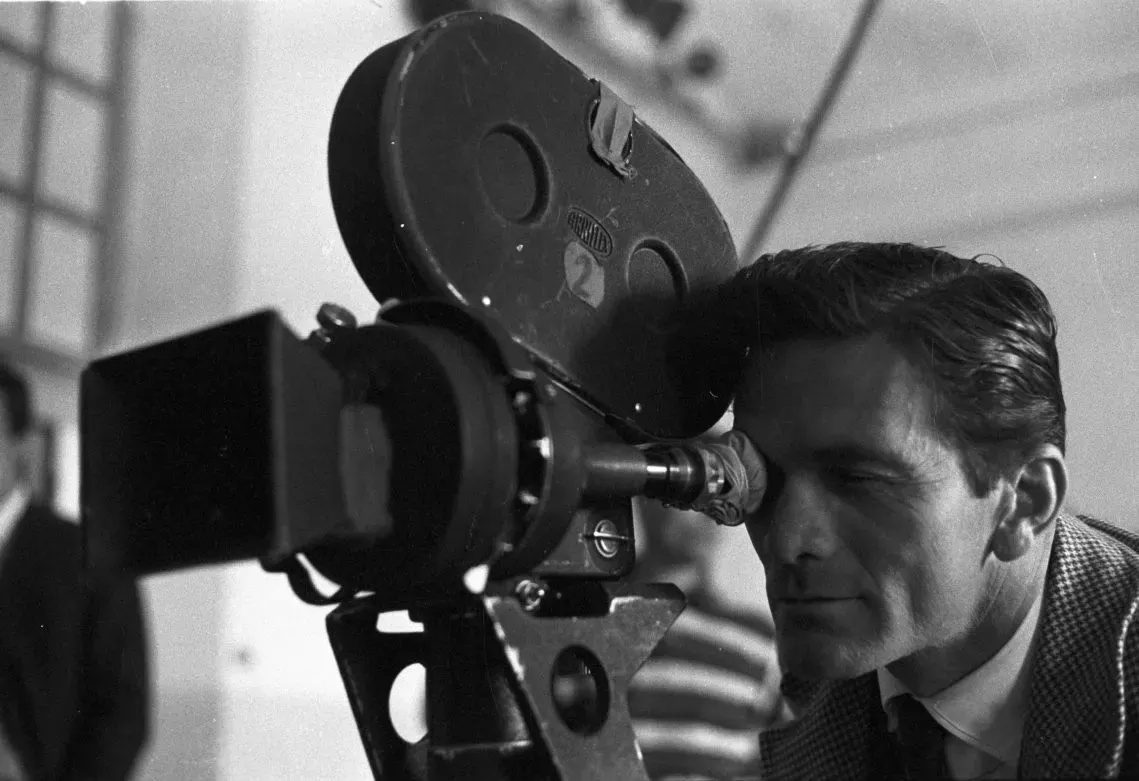
Pier Paolo Pasolini and the Renunciation of (the Trilogy of) Life
Aleksandar Stojaković
Introduction: There is a certain discomfort we encounter when attempting a discursive or essayistic—bounded by predefined norms—illumination of the life and work of a great figure. In short: one essay is insufficient; a whole book, or even a volume, is needed! Hence, a brief introduction is required, as well as disclaimers from the author, guidelines that will direct the narrative and, most importantly, serve as a form of apology to the reader. For, when faced with a personality like Pasolini, along with the vast and prolific body of work he left behind, it is not easy to decide which aspects of his life and work to cover and present to the reader. Pasolini was not just a director and writer with a rich legacy, as most know him; he was also a film theorist who reflected on the language of film and its semiotics, a critic of societal structures, and—perhaps most importantly, the core of his being—a Marxist thinker. Therefore, I have chosen, alongside a brief overview of his working methodology and theoretical considerations on film, to focus in this article on the final stage of his intellectual and artistic life and work: the Trilogy of Life and its renunciation through the film Salò, and the tragic effect of this final film—his brutal murder.
"I am the force of the past… more modern than any modern."
Pier Paolo Pasolini
Pasolini was killed by Giuseppe "Pino" Pelosi, a seventeen-year-old youth strikingly similar to the protagonists of Pasolini's novels and films. He was murdered on November 2, 1975, the day after returning from Stockholm, where he had met with Ingmar Bergman, and on the same day he stated in an interview with the Italian magazine L'Espresso that he considered consumerism to be the worst form of fascism. He was killed near Fiumicino, not far from Rome, in an area plagued by poverty and violence. Pelosi, known to friends as "The Frog" (La rana), had been released from a juvenile detention center just a month earlier, where he had served time for assault and theft. The seventeen-year-old Pelosi bore a striking resemblance to the sixteen-year-old Ettore, the son of a former prostitute trying to start a new life in the film Mamma Roma (1962). Ettore ends up in prison for theft.
Pasolini's encounter with Pelosi occurred at the Roma Termini railway station on November 1, 1975, around 10:30 PM. Pelosi was a sex worker; Pasolini offered him 20,000 lire for sexual services. They dined at the restaurant Biondo Tevere. Pelosi ate spaghetti with oil and garlic, while Pasolini drank beer. Around 11:30 PM, they drove to Ostia,1 where, according to Pelosi, Pasolini asked him to do something he refused—to sodomize him with a wooden stick. Pelosi declined, and Pasolini allegedly attacked him. Pelosi claimed he found a wooden stick (the leg of a discarded table at a dump) and used it to beat Pasolini to death, then repeatedly ran him over with his own car. Three hours after the encounter, Italian police stopped an Alfa Romeo. The driver, Giuseppe Pelosi, attempted to flee but was arrested for car theft. Two hours later, Pasolini's battered and bloody body was found on the beach. "I killed Pasolini," Pelosi confessed to the police.
Pelosi was convicted of the murder of Pier Paolo Pasolini in 1976.2 On May 2, 2005, 29 years after his conviction, Pelosi recanted his confession, claiming that he had made it under threats to his family’s lives. In his new statement, Pelosi alleged that Pasolini was killed by three men with "southern accents," shouting that he was a "dirty communist."
The circumstances surrounding his murder remain unresolved. The official version attributes it to a sexual affair, but friends and those familiar with Pasolini's work suggest it was a politically motivated killing.3 Who had reason to silence Pasolini?
The 1970s were an especially violent decade in Italy. The political climate in the country, along with the violence, surpassed anything else happening in Europe at the time. Neo-fascist groups carried out murders and other atrocities in the name of ideology.4
In 1975, Pasolini, already deeply despised by the right, completed his most controversial film, Salò: 120 Days of Sodom. Additionally, a series of critical articles against the Christian Democratic Party significantly increased the risks he faced. In these articles, Pasolini accused the party of numerous crimes and threatened to reveal more information in the near future. The accusations were not trivial—Pasolini implicated the government in bombings in Milan, Bologna, and Brescia. This campaign was so intense that then-Minister of the Interior Giulio Andreotti publicly responded to the allegations.
The right-wing press was already waging a fierce battle against Pasolini, and by 1975, tensions reached their peak based on mere rumors about his film. Threatening letters began arriving during the filming, and the final scenes were shot under police supervision on set. Pasolini posed a threat to the ruling structures. Is the theory of political assassination merely a conspiracy theory, or does it have clear and undeniable foundations in the political circumstances surrounding Pasolini?
Who killed Pasolini? Was it the seventeen-year-old Giuseppe Pelosi?
Introduction to Pasolini: Far Behind or Far Ahead of His Time
Pier Paolo Pasolini left behind 23 films (12 of which were feature-length), created between 1961 and 1975, six written plays, eight novels (including one unfinished, published in 1992), twelve poetry collections, and eight essays. He described himself as a cheerful person who only became serious on certain occasions. Pasolini was one of the most significant Italian filmmakers, an intellectual with a broad spectrum of interests—a poet, prose writer, essayist, screenwriter, director, painter, thinker, Marxist, atheist, and homosexual.
He was born on March 5, 1922, in Bologna and was named after his uncle. His father, Carlo Alberto Pasolini, was an officer, a member of the ruling class, and a fascism sympathizer. Pasolini had a younger brother, Guidalberto. His mother, Susanna Colussi, was an elementary school teacher. Pasolini described her as sensitive, devoted to her family, and submissive to his father. She hailed from the patriarchal town of Casarsa. After his father’s imprisonment for debt, his mother returned with her children to her hometown in the Friuli region.
By the age of seven, Pasolini began writing poetry, inspired by the beauty of Casarsa and the surrounding nature. “When I was seven and a half, my mother wrote a sonnet that, for reasons unknown to me, was dedicated to me. Through that sonnet, I understood what poetry was—I realized it was possible to write poetry, not just read it, and two days later, I wrote my own. I remember it was dedicated to an unidentified nightingale…”5 After that, he continued writing poetry until the age of 28, when he moved to Rome. His early poems were influenced by the poetry of Arthur Rimbaud, while his later development was shaped by Dostoevsky, Tolstoy, Shakespeare, Coleridge, and the German Romantic Novalis.
At the end of World War II, the family was struck by a great tragedy. At 19, Pasolini’s brother Guido joined the Partito d'Azione, a liberal socialist party in Italy. Guido was killed on February 12, 1945, in an ambush by Italian Garibaldi partisans serving Tito’s movement in Yugoslavia. Pasolini maintained deep affection for his late brother and expressed his love even decades later: “… I perceived Friuli as a kind of pleasant yet simultaneously tragic exile. A kind of prison where I could indulge my narcissism, surrounded by the mulberry trees, vineyards, and green meadows of Friuli, while also grieving my brother’s loss at the end of the war. He was a partisan. In fact, my brother represented—and still represents—not only sorrow but everything I wanted to be. […] The pain I feel within me still lingers because, when he died, I forced myself to not think about it, to be immune, untouched, and strong enough to support my mother through that moment. As a result, I never overcame that pain, and it remains within me.”6
On his family, Pasolini said: “I never spoke about the importance of family. I am against family. Family is an archaic remnant. During my childhood, I had certain conflicts with my family, whose background was definitively middle-class. My father represented the worst element I could imagine. It’s difficult for me to talk about my relationship with my father and mother because I know a little about psychoanalysis. What I can say is that I feel great love for my mother. My origins are those of a typical petty bourgeois Italian society. I am a product of the unification of Italy as a republic.”7
Pasolini did not love his father: “My father was a nationalist, almost a fascist, and had a formal understanding of religion: church on Sundays. […] It’s difficult for me to talk about my father because he was so different from me, and because I had a very difficult relationship with him. My father was an old-fashioned officer and thought in a way completely opposed to mine. So, the differences were both ideological and personal...”8
In 1939, he graduated in literature from the University of Bologna. In Casarsa, he secured a position as a professor at the Faculty of Philology. However, after a few years, Pasolini moved to Rome.
In 1947, he joined the Communist Party of Italy. Two years later, he was publicly accused of being homosexual, which at the time marked the end of his political career, resulting in his expulsion from the party. Nevertheless, he remained close to the party, criticizing it for its bureaucratization and lack of revolutionary vigor.
His first novel, Ragazzi di Vita (The Hustlers), was published in 1955. The book stirred controversy and public condemnation, particularly from the Christian Democratic Party, which was in power at the time, and also from the Communist Party, which criticized the novel for lacking a "positive hero" and a clear perspective. The main reason for the accusations of offending public morals was linguistic mimesis—the use of Roman dialect intended to authentically convey the tone of the suburban youths he described. On the other hand, the novel earned him recognition as a writer. Starting in 1954, he gradually entered the world of film as a co-screenwriter and dialogue writer. In 1957, he worked as a co-screenwriter for Fellini's Nights of Cabiria. His first film, Accattone! (The Beggar!), was released in 1961.
Moving to Rome marked a new chapter in his life, one that would define the obsessive preoccupations of his subsequent work. This was a period of trauma and crisis for Pasolini. Coming from the provinces, where he had been surrounded by peasants and craftsmen his entire life, he entered the heart of neo-capitalist civilization. Stunned and confused, he found himself in Rome—the stage for his rebellion and constant public scandals, the city where his turbulent life would end brutally. In Rome, he became acutely aware of the collapse of values and the disappearance of the life he once knew. It was the clash of two civilizations: the ancient, popular, peasant one and the capitalist, consumerist one. He loathed bourgeois society, which he saw as suffocating the popular spirit. Deeply attached to the folk and authentic way of life, he opposed the formalism and hypocritical norms of the industrial world.9
The aesthetic and political experiences of his youth left a lasting mark on his life. At the core of everything was Marxist theory. The political aspect is essential for understanding his work. As an author, Pasolini remained consistent with his political self. There is no distinction between Pasolini the director, Pasolini the writer and poet, or Pasolini the critic and political figure. Before Pasolini's work stands Pasolini himself.
Film as the Reproduction of Reality: Shooting Methods, Film Language, and imsignes
Italian Neorealism10—also known as the Golden Age of Italian Cinema—emerged as a consequence of and reaction to World War II.11 It marked (and reflected) a cultural shift in Italian society. Accordingly, its themes are closely tied to attempts at revitalizing Italian society after the war. Struggles against social injustice, poverty, and portrayals of working-class life are depicted without embellishment, using authentic locations and exteriors. This was not only a deliberate artistic choice to show life as it truly was but also a practical necessity, as most film studios were destroyed during the war. The characters were often played by non-professional actors, or amateurs, who spoke in local dialects.
The essence of Italian Neorealism lay in the perspective its creators took toward life and reality—a rediscovery of authenticity after the sentimentality of fascist cinema. Its aesthetics demanded unconditional justice and documentary-style authenticity.12 It represented a new and original form of critical realism, striving for social justice and humanism through critique of bourgeois society.
This framework provided an artistic avenue for a Marxist-oriented thinker and artist like Pasolini. Yet, it is challenging to confine Pasolini and his body of work within the documentary norms of neorealism. This is particularly evident in his Trilogy of Life (The Decameron (1971), The Canterbury Tales (1972), Arabian Nights (1974)) - a body of work he later renounced in 197513—and his adaptations of ancient Greek tragedies (Oedipus Rex (1967), Medea (1969)). Nevertheless, narratives about social struggles and aspirations for a better life for the working class occupy a significant place in his oeuvre.
Pasolini highlighted key differences between his style and that of the neorealists:
"I always shoot short takes. That’s a fundamental difference between me and the neorealists. The hallmark of neorealism is the long take: the camera stays in one place, capturing the scene as it would unfold in real life, with people coming and going, talking to each other face-to-face as they would in reality. I never shoot long takes (almost never). I detest naturalism. I reconstruct everything. No one in my films ever speaks off-camera in a long take; they must speak directly into the camera."14
On his shooting methods, Pasolini said: "When I shoot a film, I’m always in reality—among trees, among people like you. There’s no symbolic or conventional filter between me and reality, as there is in literature. Film is an explosion of my love for reality. I have never considered film to be group work; I’ve always seen it as the work of an author. Not just the script and direction, but also the selection of sets, locations, characters, even costumes—I choose everything. Not to mention the music." 15
A significant feature of his films that aligns him with other neorealist directors is his use of non-professional actors.16 Although he occasionally diverged from this, Pasolini was adamant in his theoretical statements: _"Cinema doesn’t need actors; theater does. I say this consciously after much thought about the problem."_17 Pasolini’s work also emphasizes realism, or film as a means of understanding reality, which guided his theoretical endeavors toward developing a pseudo-grammar of cinema—a kind of generative grammar rooted in realism. He remarked: _"A dog, as a real dog, as an animal, is an excellent actor in film. A homeless person is an excellent actor without being a professional. The true language of a human being is the language of their action, their presence in the reality of their life. Cinema is a simple reproduction of that true human language—a technical reproduction."_18
Pasolini also criticized the naturalism sought by actors: _"I hate particularities and I hate naturalism. Actors inevitably feel disappointed when working with me because I reject some of the fundamental elements of their craft—specifically, the main element: imitating naturalism."_19
In addition to using amateurs, his work often features sets that were not reconstructed in studios. Pasolini explained:_ "I use real settings. When I film, I’m essentially collecting material. I go to an actual place that hasn’t been reconstructed—one I’ve chosen in nature—and collect material depending on the lighting, on everything I find on-site. I take someone who has never acted, place them in front of the camera, and hold them there for a long time, collecting material. This means I face a major task in editing, removing all that is unnecessary to capture that moment of truth—a flicker in their eyes, a smile that happened while I was filming."_20
His obsessive use of shots and reverse shots, rejection of sequence shots21, alternation of close-ups, avoidance of over-the-shoulder shooting, and exclusion of characters entering or leaving the frame—all of these are hallmark characteristics of Pasolini’s films.
Pasolini’s theory of film art revolved around the relationship between film and reality. His theoretical work was heavily influenced by structuralism and contemporary linguistic theories. Consequently, his discourse on film as an expressive language began with semiotics. In For a Film of Poetry (1966), Pasolini reconstructed and reevaluated film language in relation to free speech, equating direct speech in literature with the subjective shot in film. He posed the following challenge regarding film language: _"While literary languages22 base their poetic discoveries on the institutional foundation of a language for official use, which is the shared property of all speakers, it seems that film languages are based on nothing; they have no actual foundation in any communicative language."_23 He explained: _"People communicate with words, not images. Thus, a language characterized by images would appear to be a pure and artificial abstraction."_24 Nevertheless, Pasolini argued that film communicates and therefore must rely on signs. Alongside systems of signs, he emphasized the importance of mimetic signs, which, together with the former, form a communicative whole. However, these signs can exist independently through a series of "communicative archetypes in nature."
The central idea Pasolini continually returns to is the speech of imagined reality: based on non-verbal signs, the speech of reality becomes verbal speech, which is then translated into the language of film—a written language of reality. It is also important to note that in his considerations of cinematic language, Pasolini does not address the sound aspect of film.
A key question discussed in film theory from the 1920s to the 1950s was: What is cinematic, and what, despite appearing in film, is not? For Pasolini, film is a "natural" record of reality that is genuinely articulated and composed of distinct, autonomous signs.25 He defines the art of cinema as semiology rooted in the nature of reality. It becomes a "written language" derived from the reproduction of visual reality—a medium for recording the meaning of reality and expressing that meaning.26 This theory differentiates between signs that indicate the presence of intent and those that suggest its absence. We live surrounded by visual signs, and our encounter with the visual world is natural. Every day, we encounter images that are unintentional signs—not part of an individual's intent but part of a general, socially accepted intent, conventionally incorporated into every symbol. To distinguish between natural and non-natural signs, Pasolini introduces the term imsignes, which denotes created images, non-natural, image-signs. These signs are akin to linguistic signs because they are intentional, created, and invented. For Pasolini, cinema blindly reproduces the signs and symbols of the natural visible world, but at the same time, it produces imsignes. Thus, the filmmaker's task is to identify imsignes and use them to express reality.27
Pasolini provides two definitions of film: (1) film as a means of expression and (2) film as a means of meaning. In his theoretical reflections, he primarily seeks to interpret film as a means of meaning. French film theorist Jacques Aumont observes that Pasolini believes the language of film both exists and does not exist. It undoubtedly exists because film can simultaneously deliver speeches and achieve understanding.28 For Pasolini, cinematic language has unusual characteristics: (1) It does not belong to a single society; it has a universal character; (2) It lacks a vocabulary and does not possess abstract expressions; instead, it relies on concrete ones situated in time and space: _"the fragility of cinema - its grammatical markers are the objects of a world that continuously unravels chronologically—fashion of the 1930s, cars of the 1950s."_29 (3) It does not have a true grammar or rules that shape statements.30
Film justifies its existence only if it imposes meaning on reality. According to Pasolini, creating meaning involves four key processes: (1) The process of reproduction – a technical procedure that involves portraying reality in a way that resembles that same reality; (2) The process of nominalization – the ability of a frame to represent something; (3) The process of qualification – everything in the frame that signifies and further defines it; (4) The syntactic process – montage. Jacques Aumont concludes that, for Pasolini, film is a "speech expression" that organizes (through the syntactic process) objects reproduced in their generality (via the processes of reproduction and nominalization) while preserving their particularities (through the qualification process).31
For Pasolini, film is a way of understanding reality, and cinematic art is semiology rooted in the nature of reality. Moreover, the linguistic medium upon which film is founded is of an irrational type. Therefore, the language of cinema (which both exists and does not exist) is, for now, a pseudo-language.
Salò, or the 120 Days of Sodom: The Twilight of Society
"If I believed that my filmmaking was fully integrated into society, which itself desires such films, I might not make them at all."
The film is a cinematic transposition of the novel 120 Days of Sodom (1785) by Marquis de Sade. In his adaptation, Pasolini remains faithful to the characters' psychology and the story's structure, dividing it, much like Dante’s Inferno, into: _The Antechamber of Hel_l (Anti-Inferno), The Circle of Manias, The Circle of Excrement, and The Circle of Blood. Instead of 18th-century France, Pasolini sets the story in the fascist Republic of Salò32 around 1944, Mussolini's final stronghold.
Pasolini was likely initially driven—or inspired—by the close connection he observed between power and sadism (“It is a fact that sadists have always been people in power.”33). In De Sade’s novel, atrocities are committed by four men in power: a banker, a duke, a bishop, and a judge. The characters of Curval, Durcet, Blangis, and the Bishop mirror the dynamic of fascist perpetrators toward their victims.
At its core, the plot is simple: the organization and execution of an orgy. The four powerful sadists conduct a strict selection of abducted youth from the working class, reminiscent of eugenic selection: individuals with damaged teeth or any physical deformity are discarded. What follows is horrifying torture, rape, terror, and the complete dehumanization of every aspect of the human being.
What is most striking in Pasolini’s final film is a certain rigidity. This is evident in the minimalistic approach to acting, the balanced structure of the film, the composition of scenes, the set design, and the formal transitions in editing. Pasolini, who often eschewed traditional scripts34 and allowed nonprofessional actors to improvise, now ventures into unfamiliar territory.
_"This time, I want even the nonprofessional actors to behave like professionals. Instead of selecting the best improvised moments in the editing room and syncing them later, as I did before, this time I reject cuts and insist on precise text delivery to achieve a balanced dramatic structure."_35
The script is conventionally structured: all four parts of the film are of equal length, with clearly defined elements that create a rising tension (in the first two parts) leading to the climax (in the final segment). The film’s beautiful cinematography, clean compositions, and meticulously designed sets sharply contrast with the horrifying events depicted. Pasolini subjects the audience to an uncomfortable test, juxtaposing aesthetic pleasure with moral repulsion. Perhaps the most unsettling aspect of the film is the absence of heroes. There is no counterpoint to the four sadists to balance the narrative. The film concludes with Carl Orff’s Carmina Burana (specifically, the Primo Vere section), which Pasolini calls "a typically fascist piece of music."36
The film operates on two levels: political and sexual. Sadism, for Pasolini, is a sexual allegory for class struggle and power politics. In an interview37, Pasolini explains that the entire film, with its almost unimaginable atrocities, was conceived as "a grand sadistic metaphor for what is called the Nazi-fascist ‘distancing’ from their ‘crimes against humanity.’" Sadists view their victims as objects, obliterating any possibility of human connection. Pasolini notes that he did not add a single word to the dialogue of De Sade’s characters or alter any details of their actions.38 The only 20th-century references are in the clothing and architecture, underscoring that the essence of tyranny - its psychology and language - remains unchanged across time. Power always dehumanizes those beneath it.
Sadism and political power share a common ideology: they reduce human beings to objects. This is the central thesis of the film.
The film is rife with sexual scenes that Pasolini describes as characteristic of De Sade’s work: exclusively sadomasochistic in all its grotesque details.39 However, in Salò, sex takes on the form of rape and assumes a political meaning: a metaphor for what power does to the human body and mind, reducing it to a "thing." For Pasolini, this is emblematic of all authority. Drawing on his Marxist roots, Pasolini sees this as the commodification of the body, a fundamental aspect of capitalism. Exploitation, as Marx described, is essentially a sadomasochistic relationship.
Film critic Gideon Bachmann observes an intriguing personal dimension in Salò: Pasolini cannot hide his attraction to the sexual aspect of sadistic orgies, a fact he openly admits. Bachmann writes: "By using the work as a personal statement, Pasolini adds a third dimension to the film: it allowed him to evoke his own youth when, as a student, he had to leave Bologna and live in a small town within that same fascist satellite state in which he set his story."40
It is no coincidence that Salò followed Pasolini’s Trilogy of Life (1971–1974), which celebrated sexual liberation and the human body as a "supreme symbol." After embracing these themes, Pasolini places them in a dark and terrifying space of institutional violence. The trilogy, which criticized consumerism and religious hypocrisy, now stands in stark contrast to the bleakness of Salò. Pasolini renounces the trilogy in Disavowal of the Trilogy of Life, which serves as a kind of prelude to the grim prelude of Salò. While he disowns the trilogy, Pasolini insists he does not regret making it.
"I think, above all, that we must never, under any circumstances, fear being instrumentalized by the authorities and their culture. We must act as if that dangerous possibility does not exist. What is more important than anything else is the sincerity and the need to say what needs to be said. We must not betray that need in any way [...] Even if it turns out that our sincerity or needs have been co-opted or manipulated, I believe we must then have the courage to renounce them."
But what is the reason for his renunciation of the trilogy? The answer lies in the film Salo. The Trilogy of Life, and through it the celebration of the body and sex, had, as Pasolini says, their historical and ideological justifications in the democratization of the right to expression and sexual liberation.41 However, now everything has been overturned. Consumerism has triumphed.
Pasolini was one of the few who persistently warned that capitalism had become the human condition, that it had imperceptibly taken over people's lives and now dictated to them. Consumerism "managed to change the psychology of the ruling class. It is the only system that has only touched the bottom: it encouraged a new aggressive attitude, because aggression is something obligatory for an individual in a consumer society; the heroism of submission, like that of an old-fashioned peasant who stoically accepts his fate, is now quite useless. What kind of consumer would it be if they accepted a regressive, archaic, inferior position? They must fight for the improvement of their social status! And so, all of a sudden, we all become little Hitlers, little seekers of power."42
One of the characters from Salo says: _"Repressive societies suppress everything, therefore, people can do anything."_43 Pasolini explains that in so-called "repressive" times, sex was a joy, because it was practiced in secrecy and "mocked all the obligations and duties that the repressive authorities imposed."44 In contrast, in totalitarian societies, such as the one Pasolini observes, including the one in which we live, _"sex produces neuroses, because this allowed freedom is false and, above all, granted from above, not won from below."_45 This means that people do not enjoy sexual freedom; rather, they adapt to the freedom that has been granted to them. His preoccupation with the theme of granted freedom and its correlation with sexuality (because through sexuality, as a foundation of class rebellion, it is most tragically outlined) manifests itself through a certain degree of concern, as "lenient societies allow some things – and then only those things are allowed."
_“Until now, society has been repressive. Today, it offers us only the false side of permissiveness. One character from my film actually says: 'As long as society forbids everything, a person can do anything. When society permits something, then only that is allowed.”_46
In the preface of the booklet Return of the Sages, Aleksa Golijanin states that capitalism must be viewed anthropologically, as a culture, as a way and understanding of life, and not just as a form of production and administration; thus, it can only be overcome as a culture, as a whole, by another cultural paradigm that would have no points of contact with this one – except for the essential human content, which has, until now, withstood all social formations.47
The youth are victims of the terror of the authorities in Salo, just as they are victims of consumerism in the capitalist system. Pasolini’s relationship with the youth of that time was quite complex. He believed that it was impossible to establish a cultural connection with them because they lived according to the new, consumerist values, which had nothing in common with the old ones he referred to. There is a loud gap between him and the youth, so he has no doubts about whether they will understand his last film – he believes they will not."
_"They speak, laugh, and behave the same way, make the same gestures, love the same things, ride the same motorcycles... In short, I saw uniforms. As a boy, I saw the Fascist youth, but I didn't notice that people conform as they do today. […] Those who don't like peasants don't understand their tragedy. Those who don't like young people don't care about them. They don't care, because they don't love them. Since they didn't love yesterday's youth, they don't realize that today's youth has changed. […] I have always loved them sincerely, I have always followed them. That’s why what is happening today is a disaster for me! Everything I did was dedicated to that love. All my books and narrative works speak about young people. I loved them, and I described them. But today, I couldn't make a film about those imbeciles surrounding us."_48
Consumerism has kidnapped young people. It has created and revived their hermetic relationships and connections. Couples have become popular, but these are "false and insincere couples." These are "consumerist couples who buy."
In filming the execution scenes at the end of the film, in Blood Cycle, Pasolini used four types of killings that the legal institutions of the time still practiced: hanging, shooting, strangulation, and the electric chair, "methods that de Sade didn’t actually think of or couldn’t imagine, no matter how imaginative he was. There are also many modern additions: one young man dies with his fist raised; one woman commits suicide. All of this modernizes the story but doesn’t change its essence. I tried not to be obvious. I don’t want to hammer in some political lesson with a mallet."49
The end of the film is a dark and pessimistic confession: the historical movements of the 20th century lead to the victory of the bourgeoisie. Bourgeois ideology is essentially fascist, because consumer society is a form of fascism.
From this position, we can say that Pasolini visionary predicted the state of future youth, who will no longer know peasants and craftsmen, who will sink into bourgeois entropy. Through neocapitalism, the bourgeoisie is on its way to becoming the general human condition. And it has become.
"When the classical world is exhausted, when all peasants and craftsmen die out, when industry establishes an unbroken cycle of production and consumption, history will come to an end... With those cries, that tumult, those masses, those lights, those mechanisms, those announcements, those weapons, those armies, those deserts, under an unrecognizable sun, a new Prehistory will begin."
(La rabbia, 1963)
Footnotes
1 Suburb of Rome.
2 Dr. Faustino Durante, the forensic scientist who worked on the case of Pasolini's murder, concluded that the director was "the victim of an attack by multiple individuals." Several journalists received information from underground sources that a motorcycle had followed Pasolini's car.
3 A series of irregularities further fueled such suspicions. Questions arose: Could it be believed that a well-built man like Pasolini could have been beaten by a slim and frail seventeen-year-old? How did Pelosi have only a few small traces of blood on his clothing when forensic experts determined there had been a fierce struggle in the mud? Moreover, blood was found on the car roof on the passenger side, suggesting either that Pelosi had an accomplice or someone else was driving the car. Additionally, a green sweater that belonged neither to Pasolini nor Pelosi was found in the back seat. Pasolini's cousin stated that the sweater had not been there the day before when he cleaned the car. Meanwhile, the police approached the case negligently: they failed to collect fingerprints at the crime scene, left the car in the rain, destroying evidence, and even damaged the car by hitting a pole while transporting it to the investigative judge. As a result, forensic findings in the case were worthless. Sergio Citti, an Italian director and screenwriter who collaborated with Pasolini on the script for Salò, or the 120 Days of Sodom, offered a different version. In an interview with La Repubblica, he claimed that five men killed Pasolini: "Pino Pelosi was a boy. He was a decoy for these five men. They used him and needed someone to blame for the crime." Citti also stated that Pasolini was killed elsewhere, and his body was dumped near the beach where it was found. He was convinced the murder was political: "His death benefited everyone who feared his mind and free spirit."
4 http://news.bbc.co.uk/2/hi/entertainment/4529877.stm (last accessed: February 10, 2017)
5 Slobodan Aranđelović (ur.), Pjer Paolo Pazolini večnost vizionara: Pazolini govori, Dom kulture Studentski grad, Beograd 2004, . 55.
6 Slobodan Aranđelović (ed.), Pjer Paolo Pazolini večnost vizionara: Pazolini govori, Dom kulture Studentski grad, Belgrade 2004, p. 55‒56.
7 From the documentary film Filmmaker and Poet,
https://www.youtube.com/watch?v=hEOADd9nuKE
(last accessed February 10, 2017).
8 Slobodan Aranđelović (ed.), Pjer Paolo Pazolini večnost vizionara: Pazolini govori, Dom kulture Studentski grad, Belgrade 2004, p. 54.
9 Jugana Stojanović, Teorema: Pjer Paolo Pazolini i roman „Teorema“, Izdavačka radna organizacija „Rad“, Belgrade 1988, p. 172.
10 Italian Neorealism is a term coined by French critics for the first films of Italy's post-war period, used more out of habit than precise definition.
11 Other theorists are more precise about the origins of the neorealist movement. Dubravka Lazić, in her work Neorealism in Italian Film and Photography – Etiology, Interposition, and Specificities of Works, states: “Neorealism did not arise 'suddenly' due to the rebellious Italian spirit at the end of World War II, nor was its content and visual texture created solely due to the lack of material resources and the scarcity of that era. Its origin dates much further back, as the analysis of socio-historical conditions has proven. The 'raw' expression cannot be characterized as conditioned solely by limited access to film and photographic material, given that film authors were among the most educated in the history of the medium, while photographers were largely dependent on print media and professional engagements within specific publishing houses. The prioritization of objectivity, reality, and life’s truth is undoubtedly connected to the energy of the time and the spirit of collective resistance to fascist repression and dictatorship in Italy. Still, it is also deeply rooted in the understanding of artistic expressions from previous periods that emphasize these attributes of specific artistic expression.” Therefore, neorealism began in the late 1930s but reached its true affirmation after World War II.
12 Marko Babić, Leksikon filmskih i televizijskih pojmova 1 i 2, Univerzitet umetnosti, Belgrade 1995/97.
13 "I renounce the Trilogy of Life, though I do not regret making it. I cannot deny the sincerity and necessity with which I depicted bodies and their ultimate symbol, sex. This sincerity and necessity had various historical and ideological justifications." See: Pjer Paolo Pazolini, Pazolini 1: Odricanje od Trilogije života (1975), Bubašvaba pres, Belgrade 2015, p. 11.
14 Slobodan Aranđelović (ed.), Pjer Paolo Pazolini večnost vizionara: Pazolini govori, Dom kulture Studentski grad, Belgrade 2004, p. 50.
15 From the documentary film Filmmaker and Poet,
https://www.youtube.com/watch?v=hEOADd9nuKE
(last accessed February 10, 2017).
16 Although much of his acting ensemble consisted of non-professionals found on the streets, as in the case of Ninetto Davoli, Pasolini also collaborated with professional actors such as Oscar-winner Anna Magnani in Mamma Roma (1962) and Silvana Mangano in Theorem (1968).
17 Slobodan Aranđelović (ed.), Pjer Paolo Pazolini večnost vizionara: Pazolini govori, Dom kulture Studentski grad, Belgrade 2004, p. 56.
18 Ibid.
19 Ibid., p. 51.
20 Aleksa Golijanin (ur.), Pazolini 1, Bubašvaba pres, Belgrade 2015, p 27.
21 He condemns the shot-sequence from an ethical and moral standpoint because it does not serve the role of "written language" in the film. Instead, it creates its own language of reality and fails to convey any meaning.
22 Here he refers to the language of literary art (author's note).
23 Pjer Paolo Pazolini, Pjer Paolo Pazolini večnost vizionara: Teorijski i tehnički zapisi P. P. Pazolinija: Poetski film, Dom kulture Studentski grad, Belgrade 2004, p. 24.
24 Ibid.
25 Jacques Aumont, Teorije sineasta, Clio, Belgrade, 2006, p. 71.
26 Ibid., p. 70.
27 Ibid.
28 Ibid., p. 26.
29 P. P. Pasolini, Heretical Empiricism, New Academia Publishing, 1989, p. 139.
30 It possesses a set of "accepted forms" that film history leaves as a legacy to contemporary filmmakers.
31 Žak Omon, Teorije sineasta, Clio, Belgrade 2006, p. 28.
32 The Italian Social Republic (RSI) was founded on September 23, 1943, in northern Italy.
33 Aleksa Golijanin (ed.), Pazolini 1, Bubašvaba pres, Belgrade 2015, p. 39‒40.
34 The film Theorem (1968) was made without a script.
35 Aleksa Golijanin (ed.), Pazolini 1, Bubašvaba pres, Belgrade 2015, p. 39‒40.
36 Ibid., str. 39.
37 Idid., str 45.
38 Ibid.
39 Ibid., str. 16.
40 Gioden Bachmann, Pasolini on de Sade: An Interview during the Filming of "The 120 Days of Sodom," Film Quarterly (1975), pp. 39–55.
41 Pjer Paolo Pazolini, Pazolini 1: Odricanje od Trilogije života (1975), Bubašvaba pres, Belgrade 2015, p. 11
42 Aleksa Golijanin (ed.), Pazolini 1, Bubašvaba pres, Belgrade 2015, p. 37.
43 Salò, or the 120 Days of Sodom, 1975.
44 Aleksa Golijanin (ed.), Pazolini 1, Bubašvaba pres, Belgrade 2015, p. 19.
45 Ibid.
46 Ibid., str. 37.
47 Aleksa Golijanin, Povratak svitaca, Bubašvaba pres, Belgrade 2015, p. 8.
48 Aleksa Golijanin (ed.), Pazolini 1, Bubašvaba pres, Belgrade 2015, p. 39.
49 Ibid., str. 38.

Tekst je preuzet iz publikacije
Giants of Art and Science and Their Neglected (Homo)sexuality (2017)
Tekst je preuzet iz publikacije
Giants of Art and Science and Their Neglected (Homo)sexuality (2017)
And God Created Trans: Boldening the Margin
The documentary film "And God Created Trans", directed by Simion Rakić, promises a great deal with its pretentious title; however, its superficial provocativeness does not cross the line of stereotyping that local queer artistic production has already moved beyond some time ago.
Identity and Religious “Coming Outs”
Two Basque films — "Maspalomas" and "Sundays" — have already won over both audiences and critics, while the French film "Couture" has brought together Jolie and Garrel.
'In Every Theatre, People Would Leave"
How 'gay cowboy movie' "Brokeback Mountain" challenged Hollywood – and the US.