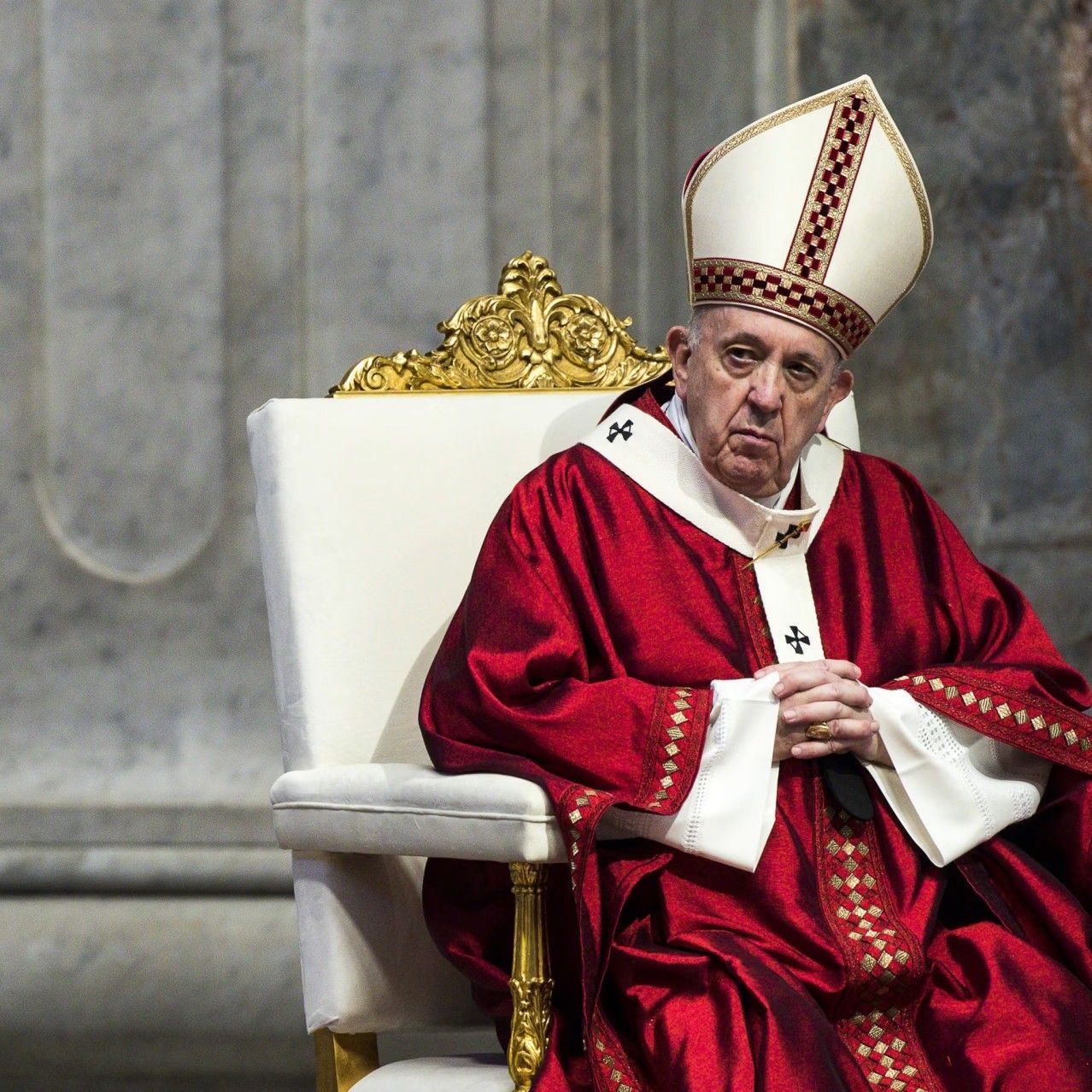
Pope Francis: A Reformer in an Unreformed Church
Vukoman Milenković
"When I give food to the poor, they call me a saint. When I ask why the poor have no food, they call me a communist."
—Dom Hélder Câmara (1909–1999), Archbishop of Recife, Brazil
The death of Pope Francis will grieve many believers, especially in the countries of the Global South, while the right wing of the Roman Catholic hierarchy—aligned with reactionary regimes from Warsaw through Budapest, Zagreb, and Dublin to Washington—will greet it with relief. Jorge Mario Bergoglio, known as Pope Francis, embodied the tensions within the Catholic Church. On one hand, he remained a guardian of the Vatican’s unjust authority—an institution complicit for centuries in class, colonial, and patriarchal repression. On the other, he was a rare figure within that hierarchy who openly gave voice to the oppressed. At a time when Western powers either supported or remained silent in the face of Israel’s terror against the Palestinian people, Pope Francis unequivocally condemned it as a crime against humanity. In terms of internal Church reforms, he made limited but barrier-breaking moves: he allowed pastoral blessings for same-sex couples—far from full recognition of Church marriage, yet a historic step; he enabled women to participate in the election of bishops—though stopping short of ordaining women priests, it still cracked the patriarchal structure of the Church.
Moreover, as the first pope from Latin America, he brought to the Vatican the spirit of liberation theology—the radical Christian socialist movement born in his homeland. Though skeptical of it in his youth, during his papacy he embraced some of its core principles: a commitment to the poor, critique of capitalist exploitation, and the link between social and ecological justice. He even expressed sympathy for socialism as an ethical alternative to neoliberalism, drawing sharp rebukes from conservatives. Yet despite this rhetoric, he firmly distanced himself from the revolutionary dimension of liberation theology, suppressing its class analysis. Instead of calling for an uprising of the oppressed, his approach remained confined to reformism and moral condemnation of injustice—but not political organizing against it.
Small Steps, Deep Cracks: Gaza, LGBT Rights, and the Question of Women
During his papacy, Pope Francis increasingly positioned himself at odds with the dominant ideological currents of Western imperialism and the Church’s right wing. His criticism was not merely rhetorical; in some cases, like his condemnation of Israeli terror against Palestinians, it directly challenged the political and religious hegemony that has justified the slaughter of Muslims in the Middle East for decades. When Francis called Israel’s crimes in Gaza "terrorism" and compared them to the Holocaust, he was condemning not just Tel Aviv but also the "civilized" West that funds these massacres. His words resonated powerfully among the peoples of the Global South—a reminder that a voice against imperialist violence could still emerge from the Vatican, despite its colonial past.
On women’s rights within the Church, Francis made symbolic but significant moves. In 2021, for the first time, he allowed women to vote in bishop elections, breaking with centuries of exclusion from decision-making. "We cannot imagine a Church without the crucial role of women," he declared—while still rejecting female priesthood. This duality—between including women in governance while denying them full clerical rights—reflects the central tension of his papacy: a willingness for certain reforms, but not radical restructuring of power.
He also challenged one of the Catholic Church’s most entrenched taboos: its stance on the LGBT community. In December 2023, he permitted priests to give "pastoral blessings" to same-sex couples, a watershed moment after decades of institutional homophobia. "When a blessing is asked for, give it," Francis said, insisting the Church must not be "a judge that only condemns." Though he clarified this did not mean recognizing same-sex Church marriages, the move provoked fierce backlash from conservative bishops, especially in Africa, where some conferences outright refused to implement it. In Poland, Cardinal Marek Jędraszewski—who once called LGBT ideology "more dangerous than communism"—denounced the change as "destructive."
Liberation Theology: A Return to the Church, Without Revolution
Liberation theology was the 20th century’s most radical left-wing Christian movement, born from the struggles of Latin America’s poor for emancipation. Emerging in base ecclesial communities (comunidades eclesiales de base), where peasants, workers, and marginalized clergy read the Bible through the lens of their own oppression, it saw Jesus as a revolutionary standing with the poor—not just spiritually, but politically. Its core tenets were:
A preferential option for the poor, locating God’s presence among the oppressed, not in lavish clerical ceremonies or political endorsements.
A Marxist-inspired critique of capitalism’s structural violence.
The Church as a politically organized body of Christians called to actively build the Kingdom of God by uprooting inequality, oppression, and greed.
The movement paid in blood: thousands of priests, nuns, and lay activists were murdered by right-wing regimes backed by the U.S. Among the martyrs were Archbishop Óscar Romero of El Salvador, assassinated during Mass in 1980, and the Jesuits of the University of San Salvador, massacred in 1989. Under John Paul II and Cardinal Ratzinger (later Benedict XVI), the Vatican condemned the movement for its "excess of Marxism," and leading liberation theologians like Leonardo Boff and Jon Sobrino were silenced, banned from publishing or teaching.
As the first pope from the Global South, Francis brought echoes of liberation theology into the Vatican—but replaced its revolutionary core with a milder "theology of the people," an Argentine variant that avoided Marxist terms and class struggle while retaining a focus on the poor.
Though initially reserved as a young priest and bishop, Bergoglio began reclaiming his "native" theology from 2013 onward. This was most visible in his rehabilitation of liberation theologians: Gustavo Gutiérrez, the movement’s founder, was invited to celebrate Mass with Francis and the former head of the Doctrine of the Faith—an unthinkable gesture of reconciliation. Leonardo Boff was consulted for the 2015 encyclical Laudato Si’, where Francis merged ecological struggle with liberation theology: "To hear the cry of the poor is to hear the cry of the Earth." Punishments against Miguel d’Escoto and Ernesto Cardenal—priests who supported Nicaragua’s Sandinista revolution—were lifted.
His socialist leanings were evident in many speeches. He denounced the "dictatorship of the market," the "profit-driven logic that kills," and advocated an "economy that serves people, not the other way around." He called for universal basic income and, in Fratelli Tutti, argued that land and resources must serve a "social function" for the common good—a key principle of Latin American socialist agrarian reform. He supported Evo Morales in Bolivia and criticized Javier Milei in his native Argentina.
Yet while reviving some concepts of liberation theology, Francis avoided Marxist analysis, rejected armed resistance, and sidelined class struggle in favor of appeals to mercy and solidarity. As Leonardo Boff observed: "It’s not so important whether you’re for liberation theology, but whether you’re for the liberation of the oppressed." Francis embraced the former—its symbolism, narrative, and reconciliation—but not the latter: the praxis that would upend the established order. His papacy remained a paradoxical blend of prophet and diplomat, where the vision of liberation retained its Gospel tone but lost its revolutionary edge.
The Power Was Never in Rome
Francis’ legacy cannot be separated from the shadows of Argentina’s dictatorship (1976–1983). As a young Jesuit provincial, Bergoglio was accused of passivity—or even collaboration—in exposing two priests to the junta’s repression. Though some accusers, like Father Jalics, later softened their claims, the truth remains murky. What is certain is that as a Church leader at the time, he did not confront state crimes—casting a long shadow over his later advocacy for the poor. His past silences made his later words louder, yet also more ambiguous.
This ambiguity defined his papacy: between silence and witness, radical message and institutional continuity. Though he opened doors to long-suppressed issues—from liberation theology to LGBT and women’s rights, to open critique of imperialism—he did so without disrupting the Church’s power structure. His reforms were profound yet limited, bold in form but cautious in substance.
Precisely because he remained trapped between prophet and diplomat, between hope and compromise, Francis’ papacy exposed the limits of institutional change from within. The reforms he enacted—however significant—did not originate in the Vatican but were responses to pressure from below: the cries of Gaza, the persistence of women serving the Church without a voice, the faith of LGBT Christians who refused to renounce God even as the Church renounced them.
The true power of liberation theology was never in papal encyclicals, but in the hands of base communities, rebel theologians preaching despite bans, and workers who read the Bible not as a book of obedience but resistance—organizing, striking, building alternatives. If Francis showed that a pope could speak against imperialism, it remains for the people to prove that the Kingdom of God comes not from above, but from below—from the mud of favelas, the mines and fields, the streets of occupied cities, the bodies that refuse to stay silent.
In this sense, his death does not close a chapter but opens a question: not what will become of the Vatican, but what will we do with the hope he rekindled—even if unintentionally?
Pubslihed on Kontranapad.com, April 26, 2025.
The Right to Evil
But women are not only vulnerable; they are also agents. They make decisions that are neither morally spotless nor self-sacrificial, decisions that may be pragmatic, ambiguous, or driven by interests that do not align with idealized images of feminist virtue.
The Digital Laboratory of Hate
The content circulating in the manosphere rests on three pillars: narratives of a masculinity crisis, pseudoscientific theories of sex and gender, and motivational advice on how to get rich and “win” women.
Academic Freedom in a Time of Destruction
The protection of extramural speech is crucial for understanding the relationship of democracy to higher education.