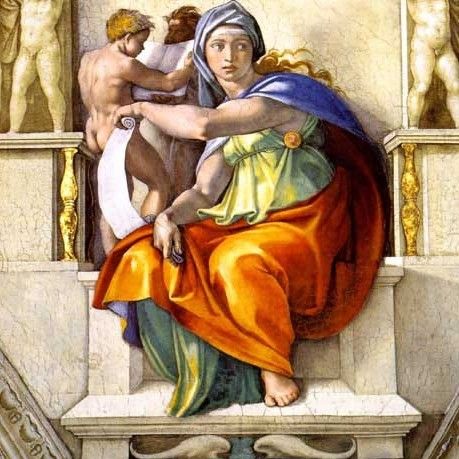
Deltoids Do Not Lie
E. R. M.
Renaissance artists routinely used men as models to depict female figures, but only in Michelangelo’s work does the musculature reveal this practice. His version of the Libyan Sibyl on the ceiling of the Sistine Chapel is difficult to describe. Before Michelangelo painted her, the prophetess was known in legends as an ancient seer. Because of her gift, early Christians assumed that she—like other sibyls—must have foreseen the coming of Christ. This is why five female prophetesses join the pantheon of Old Testament prophets in Michelangelo’s masterpiece.
Dressed in a metallic-yellow gown, the Sibyl lifts a massive tome. At first glance, a viewer might briefly wonder whether the depicted figure is a woman or a man. Such confusion is no accident; this interpretation is, in a way, a combination of both sexes. 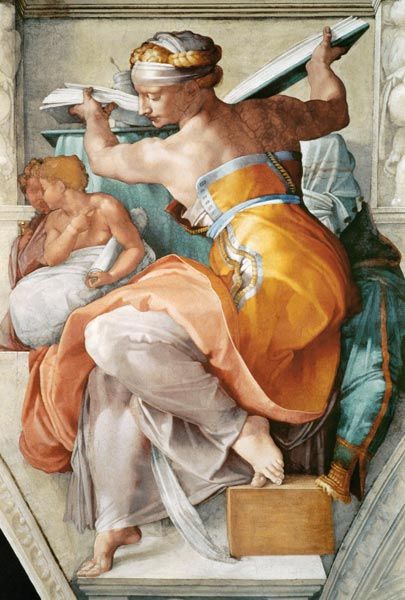 Michelangelo, Libyan Sibyl
In 1925, artist Bryson Burroughs analyzed Michelangelo’s sketches for the Sibyl and noticed that the artist had used a male model to depict her nearly nude body. On one side of the paper, a man with hyper-muscular shoulders—akin to those one might expect in a depiction of Hercules—is drawn. However, the area where hair would be is left blank, as “nothing would be gained by drawing the hair of this model in a sketch intended for a female figure.” On the other side of the same sheet, a pair of female legs is sketched. The final fresco is a kind of chimera—a blend of male and female—something Burroughs calls “beyond gender, beyond humanity.”
Though the Libyan Sibyl is a famous example of this phenomenon, Michelangelo gained a minor reputation for using male models to portray women in a way that art historian Jill Burke compares to “men with breasts.” In his Doni Tondo, the Virgin Mary’s biceps bulge as she lifts the infant Jesus, and the breasts on the sculpture Night appear as an afterthought. 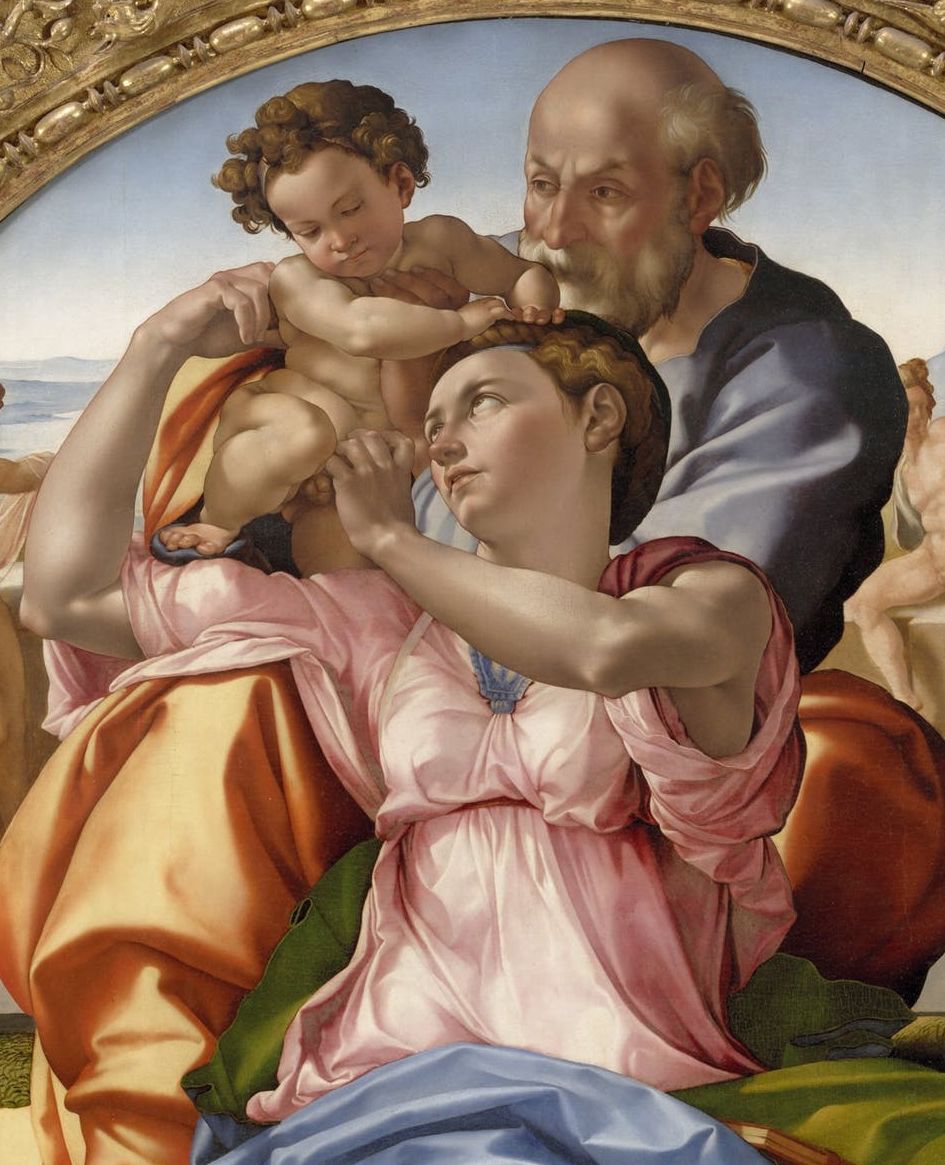 Michelangelo, Tondo Doni
Nudity, Anatomy, and Gender in Renaissance Italy
Posing nude women in Renaissance Italy was considered scandalous, but many historians argue that this moral code doesn’t fully explain the persistent androgyny in Michelangelo’s work. Raphael and other contemporaries also used male models for many female figures, but as seen in Raphael’s Saint Catherine of Alexandria, the artist still managed to depict classically feminine forms. 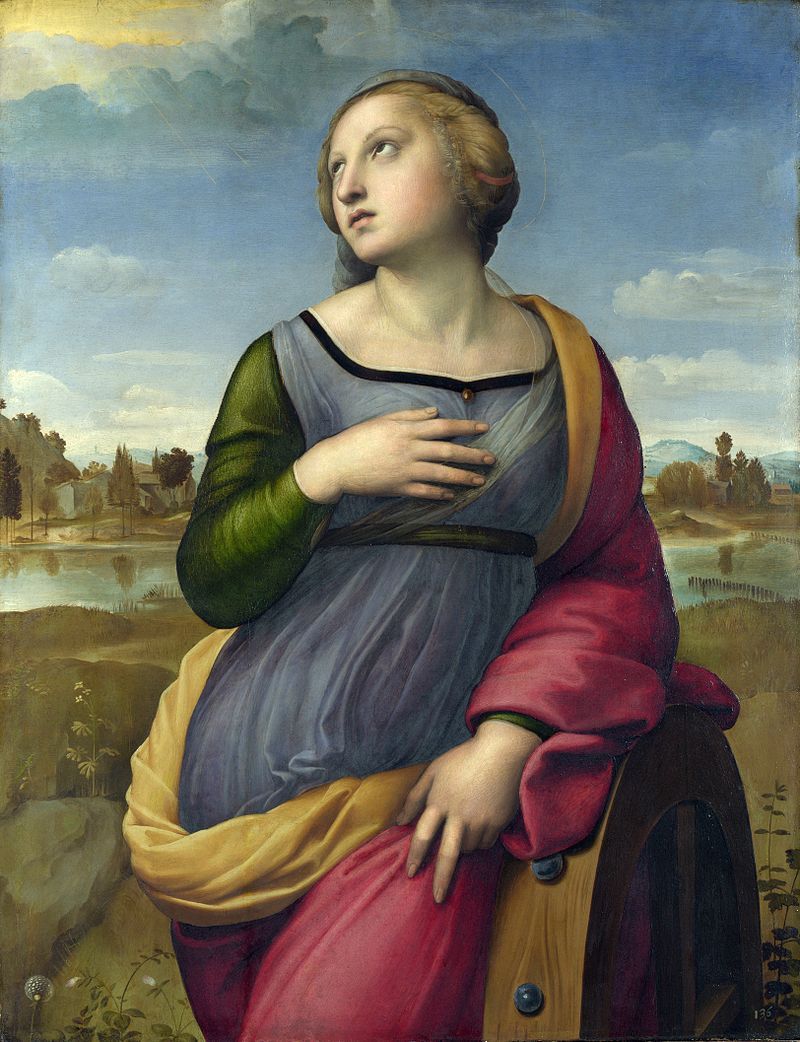 Rafael, St. Catherine of Alexandria
Some of Michelangelo’s works show that not all his women had pronounced masculine traits. He drew a female nude in preparation for The Entombment of Christ, and one need only look at his Pietà to see that he could depict women with distinctly feminine features. Rather than adhering to moral or traditional norms, Michelangelo likely used male models and created virile depictions intentionally. 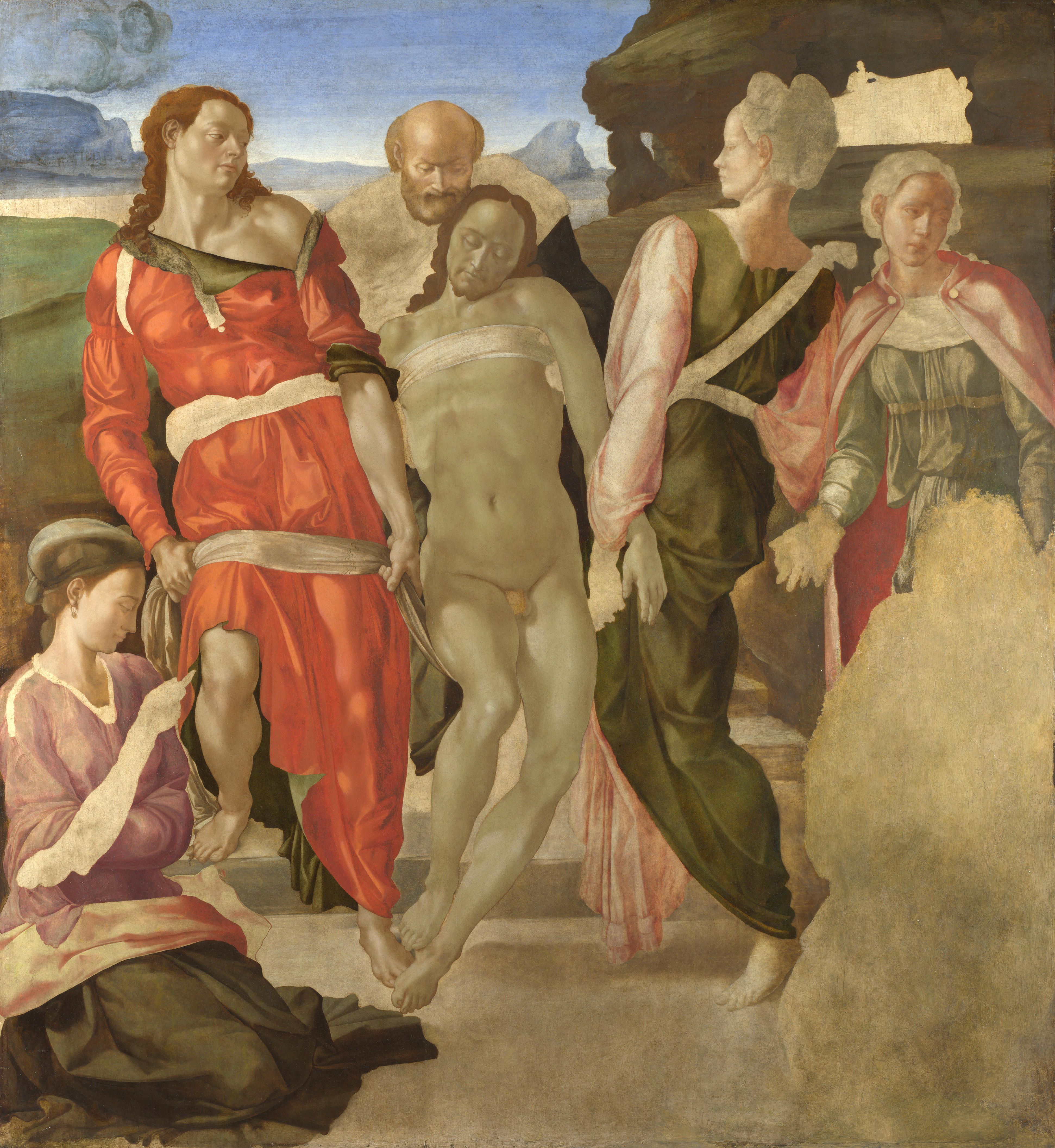 Michelangelo, The Entombment
The Artist-Anatomist
Historian Domenico Laurenza calls Michelangelo the “artist-anatomist,” exploring his work in both fields in Renaissance Italy. In the 16th century, the boundaries between art and anatomy were blurred; both disciplines relied on each other to accurately depict what lay beneath human skin. Officials in Florence even permitted artists and physicians to perform dissections. Michelangelo privately conducted dissections, developing a recognizable artistic focus on skeletal structure and musculature. Leonardo da Vinci criticized this approach, saying the result resembled “a sack of walnuts rather than a human form.” Yet even Leonardo performed dissections, leading him to the pioneering discovery that the heart has four chambers.
In his study of the Libyan Sibyl, Laurenza notes the precision with which Michelangelo rendered the figure’s distinctly masculine back. The artist marked where the clavicle meets the shoulders with a personal symbol resembling a nailhead. He also carved other notations that must have held meaning in his private system of signs, as they reappear in his other artistic and anatomical sketches. Laurenza writes that Michelangelo’s symbols “seem to lend the drawings a more scientific tone, reminiscent of the symbolic lines or letters in anatomical illustrations intended for a specialized audience.” These marks were not part of a formal muscle-labeling system but an integral part of Michelangelo’s strict anatomical-artistic syntax.
Why Did Michelangelo Masculinize Women?
If Michelangelo deliberately used female figures to explore male anatomy, the next question is—why?
Art historian Yael Even examines this question through the lens of Renaissance patriarchy. First, she considers whether Michelangelo preferred male bodies because he found them more beautiful than female ones. While some historians suggest this might reflect the artist’s sexuality, it could also mirror an era when women were often seen as physiologically inferior to the “perfect” male form. This preference might also stem from the fact that much of Michelangelo’s work was created for an exclusively male audience. The Libyan Sibyl, for instance, was made for the Sistine Chapel, a site of papal activity. 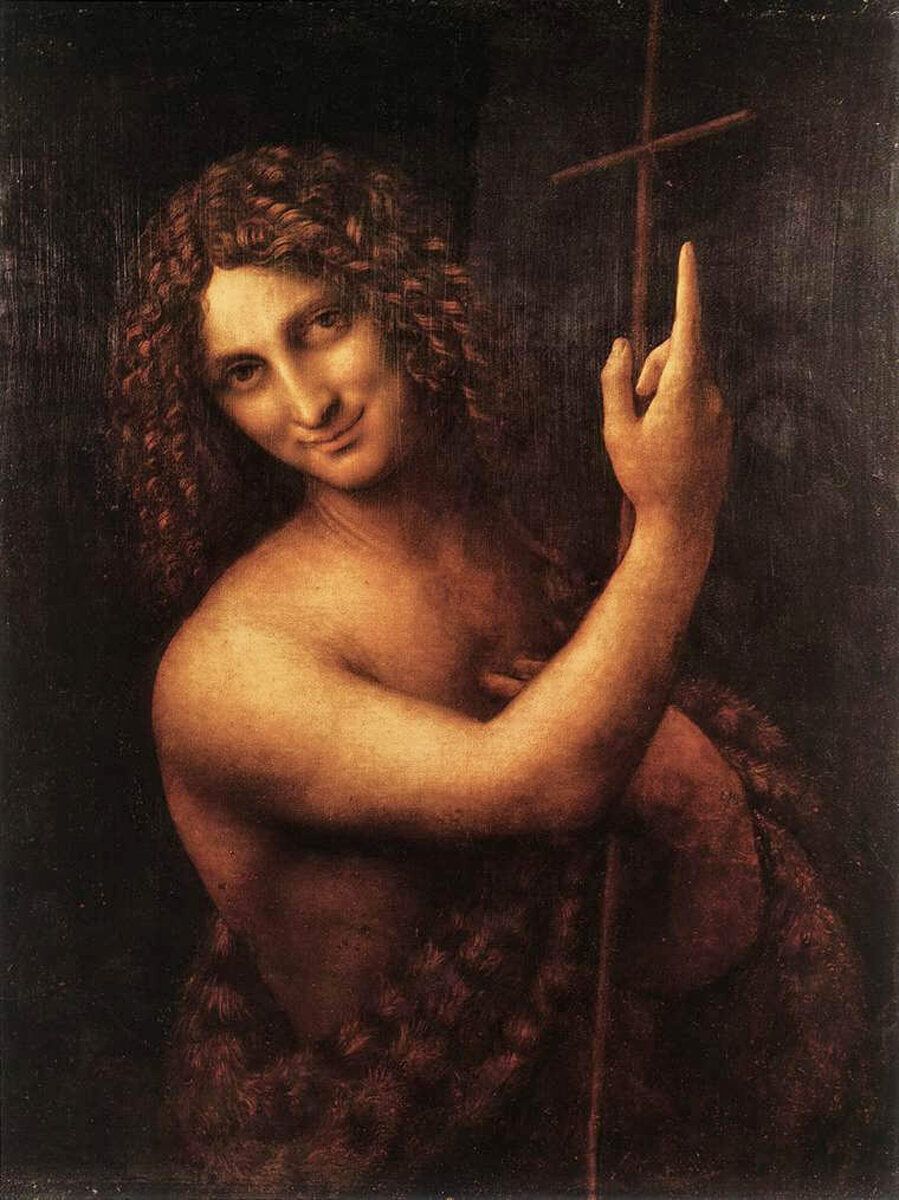 Da Vinci, St. John the Baptist
Even also explores the possibility that Michelangelo associated masculinity with power. She notes that the artist referred to his friend Vittoria Colonna—a poet and intellectual who lived independently after her husband’s death—using masculine terms. In the Renaissance, such a lifestyle was considered “a man’s way of living.” At a time when formal power rested in male hands, Michelangelo may have used masculine traits to highlight Vittoria’s unusual social power and autonomy.
Androgyny in Renaissance Art
Another (not mutually exclusive) possibility for Michelangelo’s practice is the rising popularity of androgynous depictions in Renaissance Italy. Humanist Mario Equicola wrote that a “feminized man and a masculine woman are graceful in nearly every respect.” Just as Michelangelo gave his women pronounced muscles, other artists gave their male figures delicate facial features and hips. Leonardo’s Saint John the Baptist, with his long hair and smooth skin, was described as a “beautiful youth of feminine softness.” Similarly, Donatello’s David, the shepherd-turned-giant-slayer, wears a victory wreath resembling a bridal crown. Art historian Maia Gahtan argues that androgyny’s popularity in certain circles stemmed partly from an obsession with harmony—balancing the four bodily humors or achieving equilibrium in contrapposto poses. 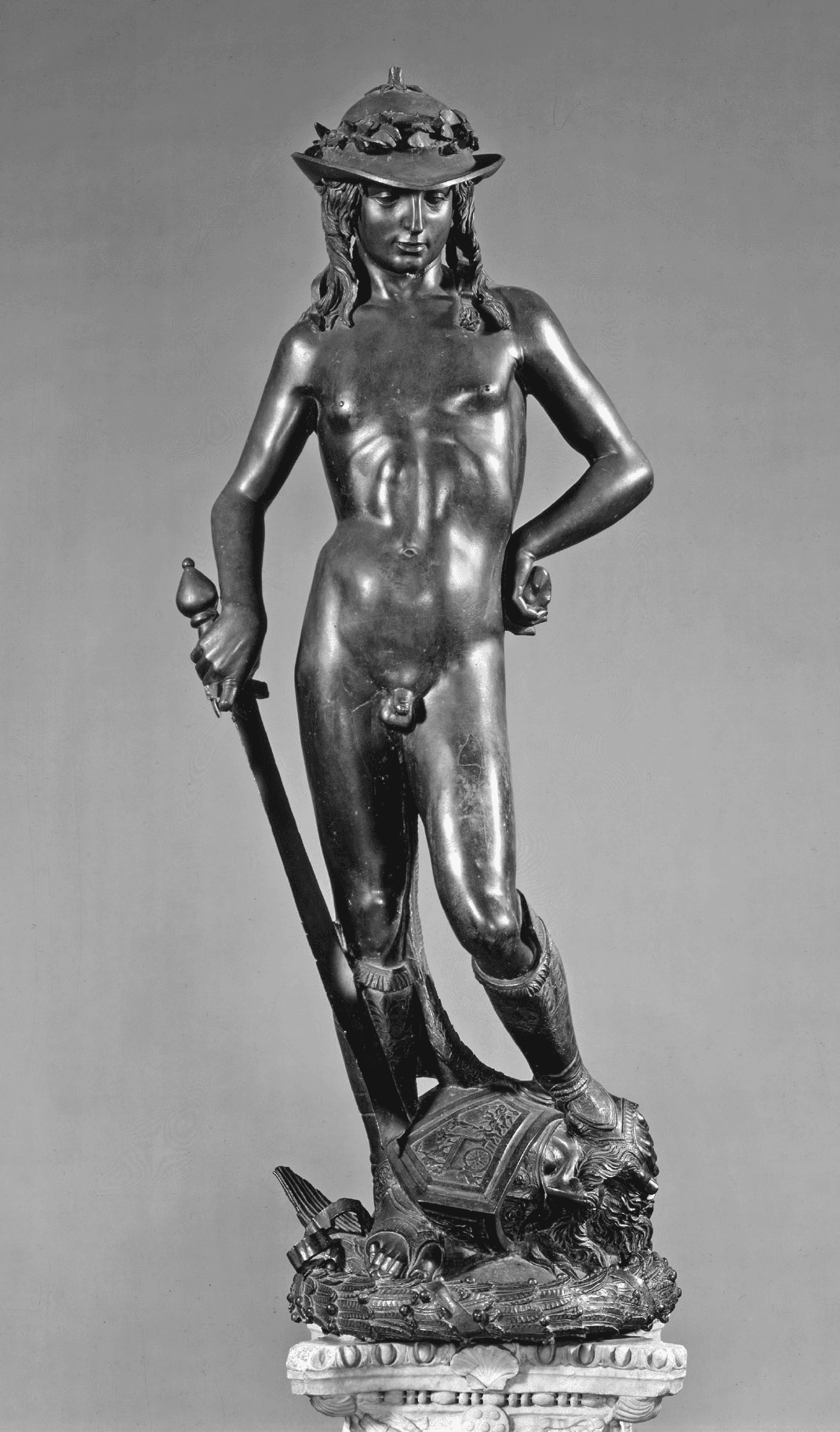 Donatello, David
Androgynous figures in art also carried religious undertones. Angels, for example, are genderless in Christian thought. Thus, blending male and female traits in a figure could bring it closer to the divine—whether a sibyl with divine revelation or a martyred saint.
Modern Echoes of Michelangelo’s Androgyny
In contemporary art, discussions of androgyny remain relevant as artists, politicians, and activists re-examine gender, aesthetic standards, and women’s societal roles. Inspired by Michelangelo, artist Cleo Newton exhibited a 2019 collection at New York’s Forum Gallery featuring modern female faces on male torsos. Art critic Eleanor Heartney described these works as uncanny, noting that “the moment of transition is imperceptible—in some pieces, it seems to happen around the shoulders or neck, while in others, the gender exchange only becomes apparent at the hands and feet.” Heartney praised their calming effect in modern gender debates: “In today’s climate, their willingness to simply be what they are offers a refreshing tonic.”
Conclusion: Art Beyond Gender
Michelangelo’s art continues to challenge, inspire, and raise new questions about gender and identity norms. Through his works like the Libyan Sibyl, we see how art can push societal boundaries. Artists like Michelangelo didn’t just document their time—they created space to reflect on universal questions of human existence, beauty, and power.
His exploration of androgyny, in an era of rigid social norms, bridges past and present understandings of gender, identity, and power.
Optimist.rs, February 25, 2025
Portrait of a Faith-Plumber
If science and technology have enabled the creation of a human being without sex through artificial insemination (‘immaculate conception’), one may expect that they will one day also enable the disappearance of the human being without death.
The Seductive Emptiness of Form
Wilde’s incisive reflections on false social morality perhaps have an even more piercing effect today, in a contemporary society where the boundaries between lies and truths have become still more fragile and porous, and where the obsession with bodily beauty and youth is far more tragic
Bolet and Marie – cryptoqueer Norwegian photography pioneers
The photography exhibition Bolette Berg and Marie Høeg, organised by the Center for Queer Studies, was held at the European House from 15 to 19 December 2025.