Evolution in Miniature
Dragana Nikoletić
The very title of the exhibition From Paper to Screen evokes the artist’s journey through media—from early drawings and graphics on paper to his recent digital works on the iPad—tracking not only his personal development but also the changing perception of works within the field of visual arts.
David Hockney, the renowned English painter, graphic artist, draftsman, set designer, and photographer, a key figure of Pop Art and one of the most important British artists of the 20th and 21st centuries, has finally returned to the Museum of Contemporary Art in Belgrade after a full 55 years. The occasion for this "homecoming" exhibition "David Hockney: From Paper to Screen," curated by Maja Kolarić, director of MoCAB, is the museum's 60th anniversary. Hockney's first arrival in Belgrade in 1970 marked the beginning of this institution’s history, as the artist was then achieving global fame.
The exhibition’s title refers to Hockney’s exploration of media—from early drawings and prints on paper to iPad works—reflecting both his personal evolution and the broader shifts in how visual art is perceived today. In fact, the exhibition opens a dialogue between past and present, material and immaterial, following Hockney’s philosophical approach, as Kolarić explained to Radar.
"Hockney questioned linear perspective as the dominant model of Western art since the Renaissance, claiming it does not reflect how the human eye truly sees. Instead of a single fixed viewpoint, like in camera perspective, people use multiple points of view, similar to how the eye and body move through space," notes the curator.
Inner Experience
New technologies further complicate the experience of observation, prompting the artist to distinguish between looking and seeing. "His digital images are not precise reproductions of reality but explorations of the inner experience of a scene," says Kolarić. Hockney offers the viewer the sensation of direct contact with still life, one of the key stimulants of his imagination.
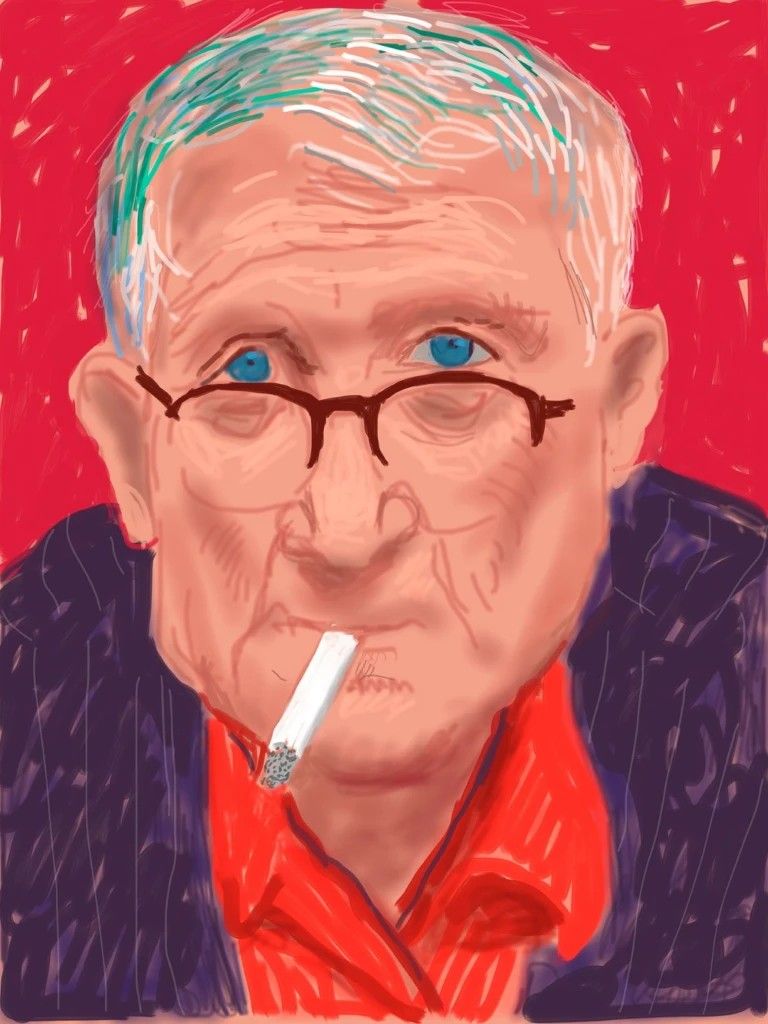 David Hockney, Self-Portrait III, March 20, 2012, iPad drawing © David Hockney
Thanks to his approach and the digital stylus, each vase of flowers on the lined-up screens convincingly emerges into the third dimension. The petals explode into vibrant color, as if they even transmit scent. On one screen, the creative process unfolds before our eyes, showing the dynamic layering of drawing, shading, and detailing as the artist’s self-portrait gradually appears.
The green walls of the exhibition space enhance the already striking effect of Hockney’s latest digital works. The viewer gets lost in space and time, compelled to "look more carefully," exactly as the artist intends. Focus sharpens through inner senses, only partly reliant on the eye.
Driven by his own sensibility, the viewer transforms into a researcher of every stroke of the electronic tool, behind which stands the artist’s vast experience honed by constant observation and drawing.
"Hockney often portrays close friends, family, and colleagues, but instead of idealization, he focuses on the subject's psychological complexity. The compositions are often formally simple but emotionally intense," our interlocutor explains. Sometimes, all elements are still gathered into a single point, a technique Hockney borrowed from classical works by Ingres and Velázquez, but the setting remains contemporary, creating a peculiar effect.
The Movement of the Eye
Hockney also abandoned Renaissance perspective in his landscapes, embracing multiple viewpoints to evoke not only the emotional experience of the surrounding world but also the sensation of moving through space.
And what happens in his famous painting "Man in a Museum (or You're in the Wrong Film)" from 1962, where Hockney’s friend Jeff Goodman shows no interest in an Egyptian sculpture at a Berlin gallery, distracted by something undefined? The title and scene suggest Hockney’s protest against the audience’s neglect of humanity’s greatest artistic achievements, a concern he shared as a recent graduate of the Royal College of Art in London. The painted exhibit itself (rendered in a Picassoesque style) seems to call the disinterested visitor to turn toward it.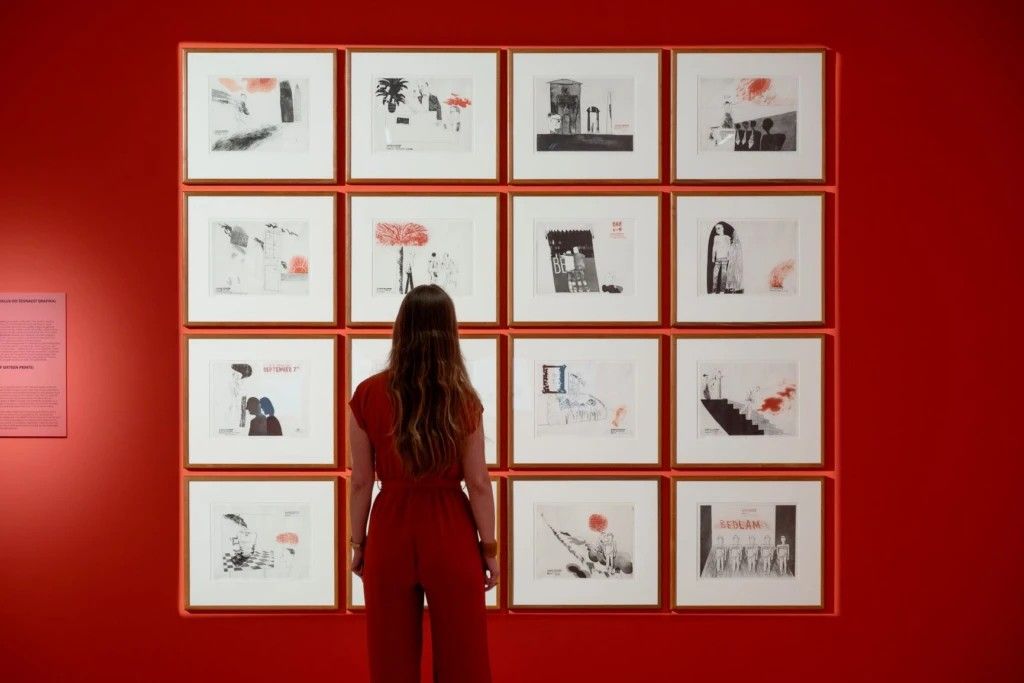 David Hockney, From Paper to Screen, photo by Bojana Janjić, MoCAB
Hockney’s youthful defiance also manifested during his college days when he had already made a name for himself in Pop Art circles. Still, he faced a "formality"—drawing a study from a live model—as a condition for graduating. In protest, he created "Life Model for Diploma," depicting an athlete facing a drawing of a human skeleton, with the young man’s genitals modestly covered by a piece of paper, perhaps symbolizing the castration of artistic potential.
This "incident" ultimately paid off. The Royal College of Art changed its rules, recognizing Hockney’s talent and growing reputation, allowing him to graduate without completing the final essay. This effectively endorsed his stance that his artistic work alone should determine his academic merit—no words needed.
The Prince on a White Horse
Yet words were not something he could entirely avoid. In the early 1970s, one of his most ambitious projects was "Illustrations for Six Fairy Tales from the Brothers Grimm," some of which are included in the Belgrade exhibition. In these etchings, we see a princess locked in a castle tower with an overly "orderly" garden that gives no hope of rescue. Her long braid hangs from a window, but in the next print, no savior is in sight.
On a third print, the prince on a white horse appears to have been driven away by a witch (seen in a fourth etching). By assembling these fragments, the viewer grasps both the moral of the fairy tale and the breadth of Hockney’s liberated imagination.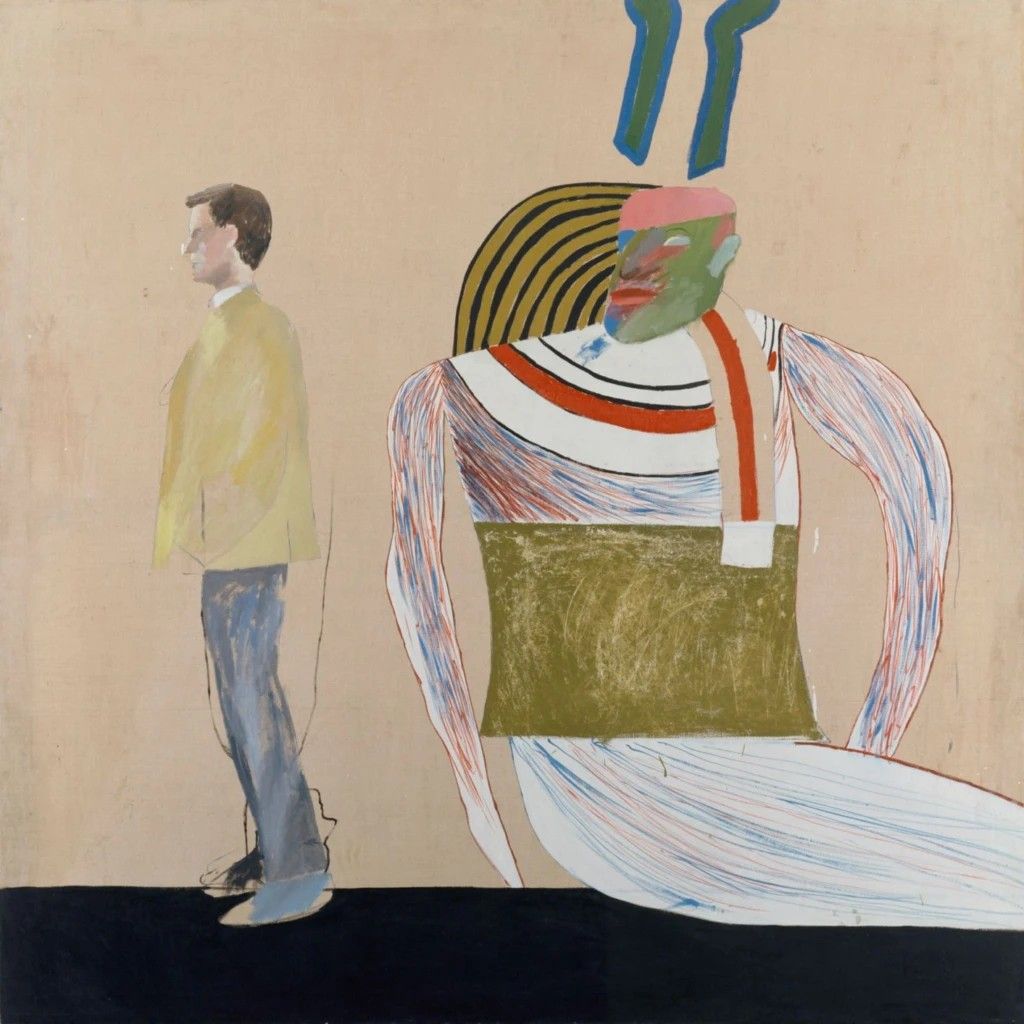 David Hockney, Man in a Museum (or You’re in the Wrong Film), 1962, oil on canvas, 147.3 x 152.4 cm, British Council Collection © David Hockney
Hockney also illustrated poems, including Wallace Stevens’ "The Man with the Blue Guitar," inspired by Stevens' imaginary conversation with Picasso’s "Old Guitarist" from his Blue Period. Hockney used both sources—the literary and the visual—questioning the role of fantasy in describing reality.
Always eager to adopt new techniques, Hockney borrowed the "sugar lift" printmaking method from Picasso himself. "It’s a very spontaneous process that preserves the full tonal range of brushstrokes in the printed image," says Kolarić. This is evident in Hockney’s series "A Rake’s Progress," based on William Hogarth’s moralistic tales. "In Hockney’s version, the story of wasted life is set in New York, and the 'rake' is a semi-autobiographical figure discovering the pleasures of life in a freer society," she explains.
Hockney’s literary inspirations continued with "Illustrations for Fourteen Poems by C.P. Cavafy," the Egyptian poet of Greek origin. These works emerged during Hockney’s travels through Egypt. "Wishing to convey the sensual atmosphere of Cavafy’s poetry, Hockney relied on personal experience, so most of the illustrations are based on intimate sketches of his friends," Kolarić observes.
Returning to Britain
Hockney’s return from Los Angeles to Britain in 2005 sparked a new interest in the changing seasons, inspired by the local climate. "That period gave rise to the series 'The Arrival of Spring,' as well as other cycles where he returned to landscape, one of his favorite motifs. Here, Hockney does not use traditional drawing or painting tools but creates directly on the screen with his fingers, producing vibrant depictions of British and French countryside scenes, which conclude the exhibition," the curator summarizes.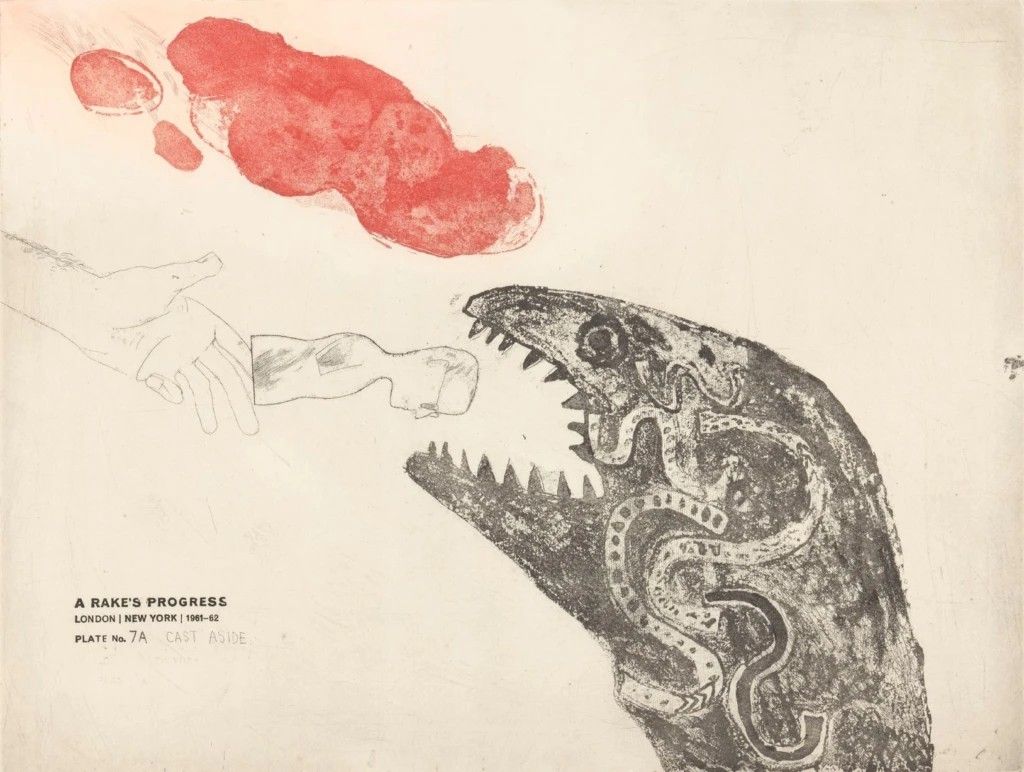 David Hockney "Discarded" from A Rake’s Progress, 1961–1963, etching and aquatint, 49.53 x 62.23 cm, British Council Collection © David Hockney
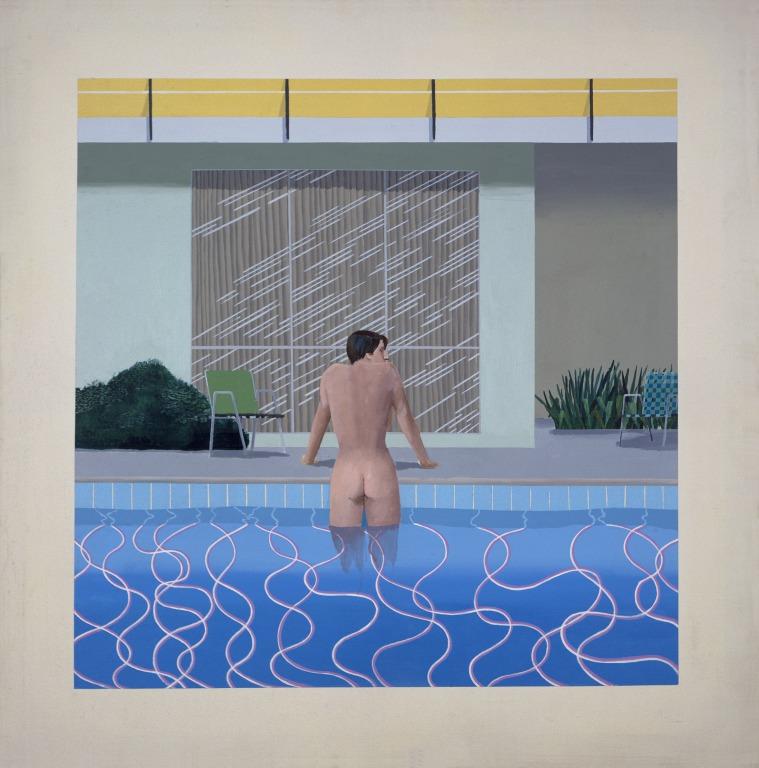
And what about his most iconic works—the paintings of California swimming pools he began after moving to Los Angeles in 1964, viewing life there through the lens of an outsider? "When we started preparing the exhibition, those works were already reserved for Hockney’s major retrospective currently on view at the Louis Vuitton Foundation in Paris. Besides, such a loan would require a huge insurance budget, given the staggering value of the pieces. But our exhibition has everything the Paris show lacks," Kolarić concludes, now speaking as MoCAB’s director.
The selection of works in "From Paper to Screen" partly comes from the British Council Collection in London, while the recent iPad works were loaned directly by the artist. Departing from strict chronology, the exhibition—on view until August 12—follows Hockney’s development from the tactile immediacy of drawing and printmaking to the digital image, offering the public a chance to witness the breadth of his artistic evolution.
Published on Radar.rs, July 4, 2025
Portrait of a Faith-Plumber
If science and technology have enabled the creation of a human being without sex through artificial insemination (‘immaculate conception’), one may expect that they will one day also enable the disappearance of the human being without death.
The Seductive Emptiness of Form
Wilde’s incisive reflections on false social morality perhaps have an even more piercing effect today, in a contemporary society where the boundaries between lies and truths have become still more fragile and porous, and where the obsession with bodily beauty and youth is far more tragic
Bolet and Marie – cryptoqueer Norwegian photography pioneers
The photography exhibition Bolette Berg and Marie Høeg, organised by the Center for Queer Studies, was held at the European House from 15 to 19 December 2025.