Machismo Dehumanizes Men
Dragan Jovićević
In my house, my father was the king. His kingdom was hyper-masculine. He was the one who rewarded and punished. These were the elements of power that I built into this performance, says the Australian choreographer about the show "King."
A dynamic week at the Belgrade Dance Festival brought us several completely different troupes, individuals, and choreographies that showcased the diversity of the contemporary dance scene. Two duos performed two opposite yet actually complementary shows. While the Greek performance by Joana Paraskevopulu and Gjorgos Kotsifakis demonstrated how a short performance about amplifying moving images and the very space in which it is performed can be dynamic and effective, the Japanese duo Saburo Teşigawara and Rihoko Sato provided a meditative, thoughtful experience, reminiscent of the deeply expressive imagery of kabuki theater or the slow rhythms of Akira Kurosawa's old films.
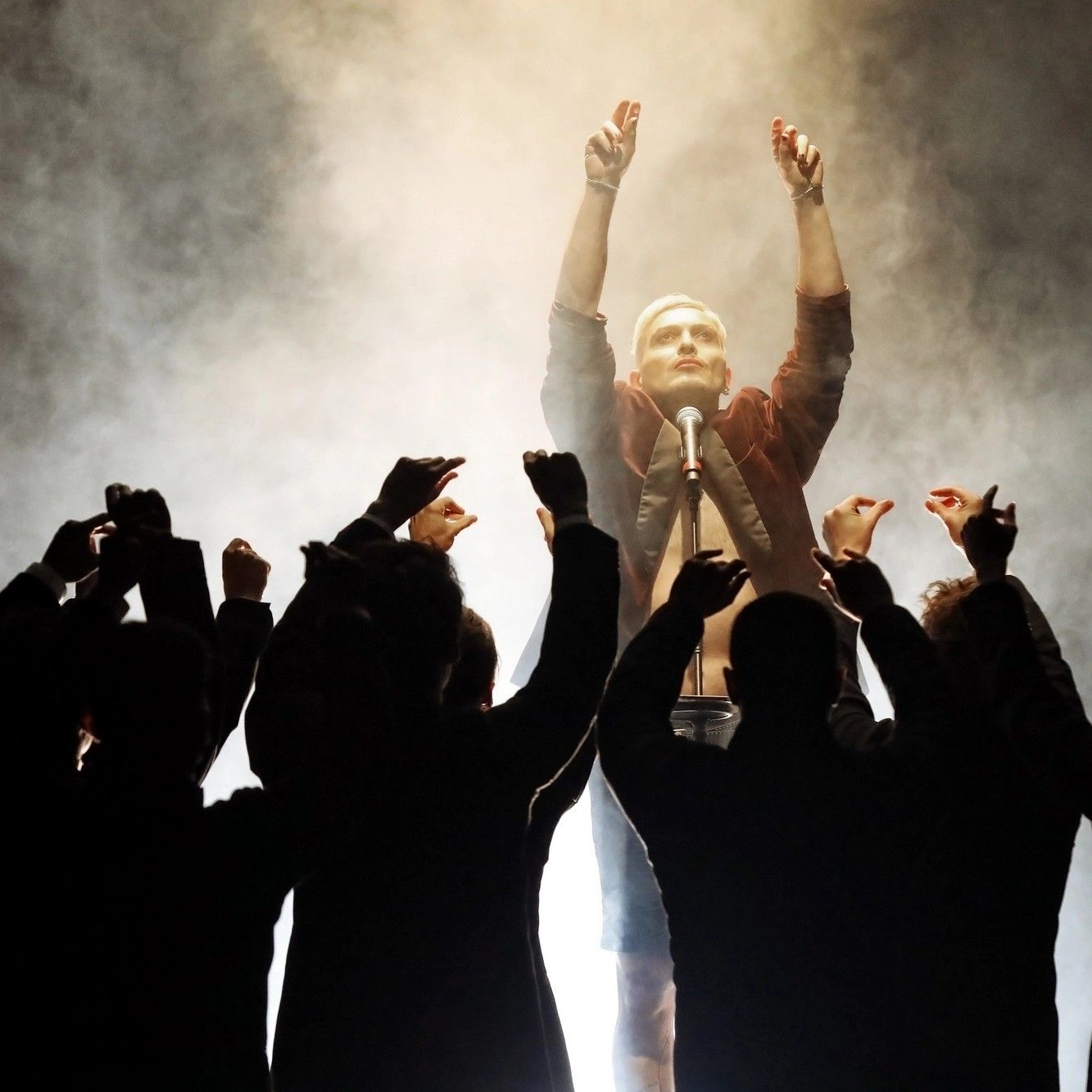
On the completely different end is the performance "King" by the Australian troupe of Sean Parker. The famous choreographer, who has previously appeared on Belgrade stages, this time brings a very interesting performance on the theme of masculinity, told from various angles. Thus, on the stage of the Theater on Terazije, at the beginning of the performance, we saw ten men - nine dancers and one singer. The dancers wore suits, while the singer was understatedly glamorous. The nine of them varied in height and stature, each one coming up to the ears of the others when lined up on stage. Beside them, the voice of Bulgarian singer Ivo Dimchev captivated from the moment he began to sing. The subsequent performance is a fierce and cathartic study of the relationships of power and strength in this still very masculine world.
Born in the early 1970s in a small town in Australia, Sean Parker admits that in such an environment, he was expected to conform to the same standards as other boys, which was a pure demonstration of masculinity, and this was his initial inspiration for the performance "King." "We boys weren't allowed to laugh or cry, and especially not to engage in such a beautiful art form as ballet," Parker tells us after the performance. "That's how all the men around me behaved. We couldn’t show any signs of femininity because we would be almost expelled. Simply put, Australia was not ready to accept any diversity back then."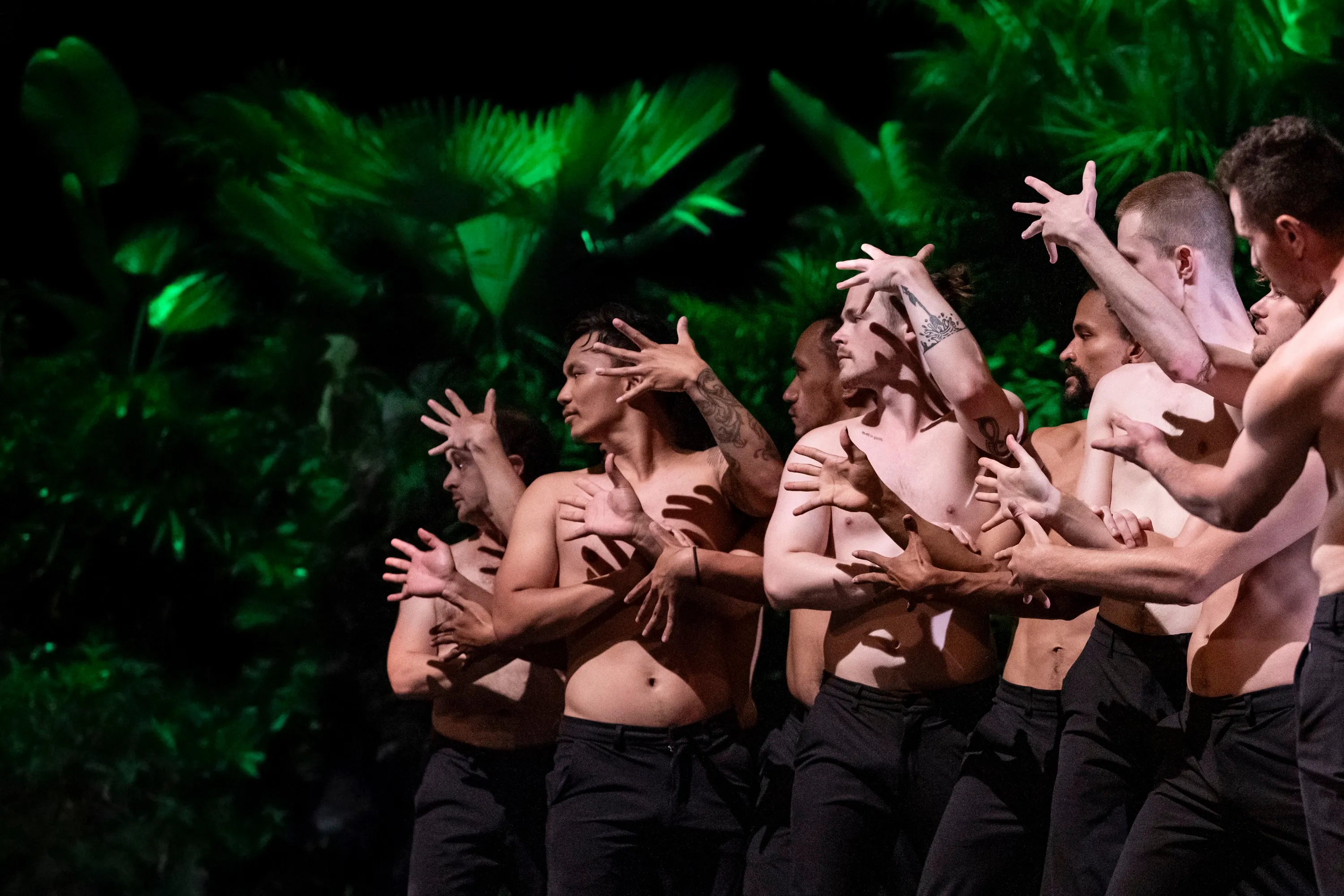 Photo: Andrea Maccia / Belgrade Dance Festival
This particularly applied to the issue of sexuality, which is inevitably viewed from only one perspective in such a macho world. "And everyone's sexuality is fluid and changeable. That's why I started this almost scientific exploration of masculinity. I gathered nine completely different men. They were my initial inspiration," says Parker, adding that some are permanent members of the troupe, while others are invited guests.
The process of working on the performance, he says, was very specific. "When we started working on the performance, I didn’t talk much with them about the concept itself so that it wouldn’t be so obvious and superficial. I selected parts from which I wanted to build the story. At first, I didn't know how it would all look. I only knew that I wanted to create some kind of dance alphabet, a guide through both the performance and the world of masculinity. So, I designed an alphabet, almost woven from words, which we then transformed into movement, and then into complete wholes. I almost wrote a script with a storyboard, which served as a guideline for what the end result of this concept would be. The images came to me; they just had to be connected."
They told us that boys aren't allowed to cry. If they cry, they are no longer men. When they become men, they are not allowed to talk about their feelings. Fortunately, today the culture has changed.
There was also the idea for me to play one role, a female one, since I normally sing countertenor. However, the musical score did not go as planned from the beginning. "For two years, I only worked on the choreography, without music. Many things were done without sound. I wanted music styled like the '70s, something that would be played in elevators, but that didn’t work out. Then, I happened to see Ivo Dimchev on Facebook through our mutual friends and was astonished. I immediately knew he had to sing all the music in the performance. That's how we met, through Facebook. However, Ivo responded that he had never worked with anyone else, but I sent him recordings of the choreography, practically the best parts. The next day, he replied, saying that he really liked the project and wanted to get involved,” Parker shares with us.
From refined appearances to bare bodies, the male dancers talk about the world of machismo, surrounded by a jungle on stage. We’re not sure what is more significant – such a sight or the very title of the piece, "King." "There is a prevailing notion in the world that tenderness is excluded when it comes to men. It is considered acceptable for a man to hit and to be hurt, but not to be tender. That’s why I saw them in tuxedos, and it was especially important to me that this group, behind the facade of the elite, ends up completely naked by the end of the performance. In that, I saw the struggle of intellect against instinct, and vice versa. Outside, it’s a jungle, and that’s why I wanted to show these strong men as a metaphor for male dominance—and then watch them deconstruct on stage. As for the title itself, it imposed itself naturally. In the house where I grew up, my father was the king. If something didn’t suit him, he would throw it and smash it against the wall. His kingdom was hypermasculine. He was the one who rewarded and punished. There were rules for living in his kingdom. And these were the elements of power I used in creating this play. I started by studying sperm itself. There are many spermatozoa in it, competing with each other to reach the egg. It’s literally a battle—they are enemies to one another. The sperm that first manages to pierce the egg wins. I realized that the struggle for power and dominance is inherent in humans because it’s woven into our very beginnings, from those microscopic units. And that’s fascinating. If we transfer this to a political level, it’s exactly the same story." 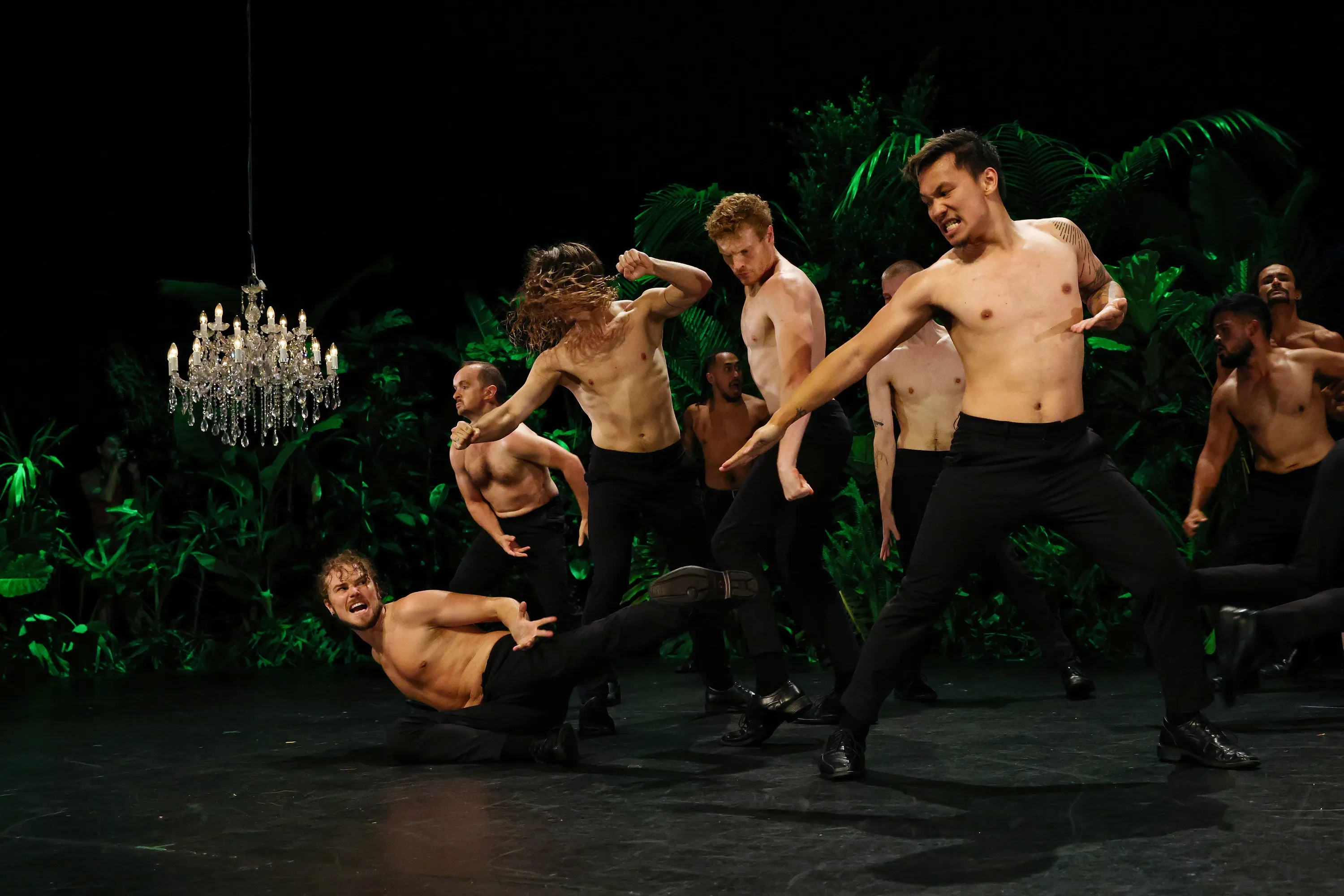 Photo: Prudence Upton / Belgrade Dance Festival
Still, the world is changing, and King also brings moments of tenderness that serve as solace in a world of brutality. "That’s because we teach boys to be strong, and thus violent. We think this will make them better, but it doesn’t. And this keeps repeating throughout history. Personally, the narrative that men must ‘be men’ dehumanizes them in many ways. Because they say boys shouldn’t cry. If they cry, they’re no longer men. When they become men, they shouldn’t talk about their feelings, especially not to other men. Fortunately, culture has changed today, but not as much as we’d like. I watch my nephew, who attends an all-boys high school, talking to his friends in a completely different way than I did in my time. I had to hide the fact that I was learning ballet. I had to leave my hometown to pursue what I wanted. Until then, I constantly heard ‘don’t do this, don’t do that.’ My freedom was extremely restricted. And yet, tenderness is actually inherent in male nature," says Sean Parker.
Even after watching the play, a strange impression lingers—no matter how much the patriarchal structure of the world changes, primal machismo will remain an inseparable part of male power, continuing to lead societies toward catastrophic consequences. Especially since that power somehow always remains in the hands of those at the highest levels of authority.
Published on Radar.rs, April 5, 2025.
Portrait of a Faith-Plumber
If science and technology have enabled the creation of a human being without sex through artificial insemination (‘immaculate conception’), one may expect that they will one day also enable the disappearance of the human being without death.
The Seductive Emptiness of Form
Wilde’s incisive reflections on false social morality perhaps have an even more piercing effect today, in a contemporary society where the boundaries between lies and truths have become still more fragile and porous, and where the obsession with bodily beauty and youth is far more tragic
Bolet and Marie – cryptoqueer Norwegian photography pioneers
The photography exhibition Bolette Berg and Marie Høeg, organised by the Center for Queer Studies, was held at the European House from 15 to 19 December 2025.