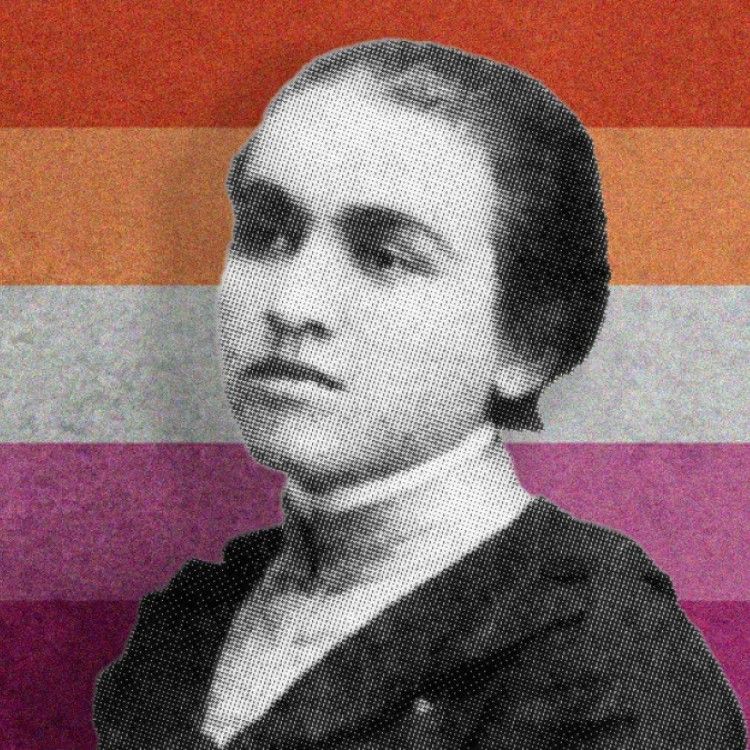
Leposava Mijušković, A Forgotten Writer
Kristina Kljajić
"And we had to part! And we parted!...
"And there, once again, at the moment of parting, we embrace and kiss as before, only this time I clearly feel that I am doing so over an abyss," says the protagonist of the story Impressions of Life, after being abandoned by the woman she loves, who left to marry a man.
This story, which might still seem provocative to some today, was published in traditional, patriarchal Serbia at the turn of the 19th and 20th centuries.
It was written by 23-year-old Leposava Mijušković at the time.
When this brown-haired girl with a high forehead and narrow face submitted her manuscripts for publication in the Serbian Literary Herald, the most prestigious literary magazine of the time, she didn’t sign them—she shyly left only her initials.
Behind those two letters was a Serbian writer praised by Jovan Skerlić, one of the most influential but also strictest literary critics of that era, for her "strong personality and completely original talent."
In her manuscript were stories that today could be classified as queer literature—works dealing with LGBT+ themes and motifs.
Leposava Mijušković's work carries something avant-garde in both its themes and writing style, explains Slavica Garonja Radovanac, a literary historian.
"Two of the four stories speak about homoerotic love between two girls, which was not a common theme in the literature of that time," says the professor at the Faculty of Philology and Arts in Kragujevac to BBC News in Serbian.
The story seems like a stream of consciousness, following internal turmoil.
"It emerges as an automatic act coming from the subconscious," the professor notes.
"Here, you believe you loved her, but it’s not so! It's not, know that!... You loved in her only the image of your imagination, thus yourself; and she loved you in the same way.
People are bound to one another either by interest or by vanity, and in your case, it was the latter! Love! Friendship! Nonsense!" says Leposava's embittered protagonist.
From Jagodina to Zurich
Little is known about Leposava Mijušković's life.
She was born in 1882 in the village of Vukmanovac, near Jagodina, in central Serbia.
"She was ahead of her time and of the small-town environment in which she grew up," Garonja Radovanac points out.
Although the daughter of a blacksmith, she went to Belgrade, where she enrolled in the Higher Women's School, which was attended by girls from upper social classes.
Her education was crucial for her artistic and intellectual development, believes Garonja Radovanac.
"A more complete biography of Leposava Mijušković cannot overlook the role of the Higher Women's School, which educated the first generations of systematically and thoroughly educated women from the upper classes, many of whom went on to study abroad," she explains.
Mijušković continued her education in Zurich, where she later worked as a teacher.
It was no coincidence that she chose this city, as Switzerland at the time was more liberal than the rest of Europe.
Zurich was a place where socialist ideas were being born, and where people like Nikola Pašić, Svetozar Marković, and the Russian revolutionary Mikhail Bakunin studied.
Leposava "loved to retreat to her room, sink into an armchair, wrap herself in a thick cloud of smoke, lighting one cigarette after another, and work," writes her contemporary and acquaintance, Elza Kučera.
"At that time, she would dissect her own soul with a knife. Weeks would pass without her leaving her room, when she wanted to write something.
"She hardly ate or slept.
"Neither reasoning nor pleading helped. She would tear up what she had written and start over..." Kučera writes after Leposava Mijušković’s death in 1910.
In her first published story, Mijušković "intensely analyzes lesbian homoeroticism, which is a form of transgressing all norms and prohibitions," writes Jelena Milinković from the Institute of Literature and Arts in her work Love as a Performative Act in the Stories of Leposava Mijušković.
She wrote during the early stages of feminism in the Balkans, a period that gave rise to key figures and paved the way for literature between the two world wars, Milinković writes.
"Due to the specific position women held in Serbia throughout its history and the neglect of literature they created, many texts remained in manuscript form or were published exclusively in periodicals, only to be published in book form at the end of the 20th century," she writes.
This is exactly what happened with Leposava Mijušković’s works, which were first published decades later by a relative.
That she was aware of the societal constraints around her is shown in a passage where, though writing about the woman she loved, her protagonist realizes that nothing remains for her "but to marry and bear children."
'Fear of Authorship'
At the beginning of the 20th century, when women began to emerge on the literary scene dominated by men, their writing was often seen as separate, and critics labeled it under the same umbrella—women’s literature.
Many female writers didn’t sign their works but used pseudonyms, and like Jelena Dimitrijević, Danica Marković, and Milica Janković, Mijušković used a different name.
Even when Jovan Skerlić revealed her identity in his comments on her prose, she continued to sign only with her initials.
The pseudonym brought freedom, believes Ana Parejo Vadillo, a professor of Victorian literature at Birkbeck.
"That sense of liberation from gender, liberation from sex, in a time when these categories were very fixed in people's minds, was very important to her," she said earlier for BBC News.
Women published less often than today but were not entirely invisible, says Bojana Antonić, a professor of literature and language, for BBC News in Serbian.
Female writers opted for a kind of intimate prose because it was expected of them.
Yet through that "sentimental, naive, and confessional tone, they addressed some provocative themes," Antonić believes.
From Forgotten to a Patron of Queer Art in Serbia
Although published in 1905, Impressions of Life by Leposava Mijušković wasn’t the first story with homoerotic motifs in Serbian literature, Garonja Radovanac reminds us.
"Her predecessor, writer Jelena Dimitrijević, wrote about lesbian relationships in a harem," she points out.
Leposava Mijušković’s prose was long forgotten and only recalled indirectly by Dragiša Vitošević in his doctoral dissertation on the Serbian Literary Herald in the 1990s.
He almost entirely overlooked the love relationship between two girls in the story, Antonić points out.
The decades-long neglect "has more to do with the relationship between erotology and literature, which only began to be seriously studied in the mid-20th century," she believes.
"Her prose also deals with unconventional heterosexual relationships, such as the relationship between a younger woman and an older man," Antonić adds.
Leposava Mijušković died in 1910 at the age of 32, having written only four stories, which may have contributed to her decades-long obscurity, says Garonja Radovanac.
Her death, too, is shrouded in mystery.
Myths have circulated that she participated in a duel or shot herself because of unrequited love, but there is no reliable information.
A century later, an award bearing her name is presented in Serbia for prose literary forms with LGBT+ themes.
BBC News in Serbian, September 9, 2024
Islamic Lietrature and Homoerotism
For centuries, literature from Islamic regions, especially Iran, celebrated male homoerotic love as a symbol of beauty, mysticism and spiritual longing. These attitudes were particularly pronounced during the Islamic Golden Age, from the mid-8th to mid-13th centuries.
Queer Heroine of Culture: Zinaida Nikolayevna
The independent, ‘unrestrained Amazon’ Zinaida was characterized by an exceptionally curious mind and sharp intellect, versatile education, refined taste, and a pronounced inclination for aesthetics in the broadest sense. She was aware of her more than pronounced femininity, subtle erotic appeal, and specific beauty.
Scholars Discover New Poems from Ancient Greek Poetess Sappho
Only a few poems of the Greek poetess Sappho’s work have survived but thanks to a leading scholar’s investigation two new works have just been recovered—and gives experts hope to find more.