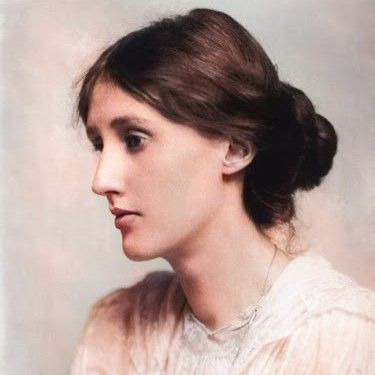
How I Saved Myself With the Help of Virginia Woolf
Bojana Popov
I would first like to greet you all and thank the organizers and participants of this course for the initiative and willingness to discuss topics such as stigma, marginalization, and madness. Today, I hope to present my own story about "madness" in an aesthetically acceptable manner and provide a theoretical commentary based on the best literature I have encountered. In accordance with my artistic temperament and inclination, I have experienced my madness as a challenge that stimulates creative reactions. Similarly, I have perceived the psychiatric system due to its undoubtedly oppressive and dogmatic nature. For me personally, the psychiatric system is both a prison and a stimulus.
My story will begin and end with the brilliant Virginia Woolf, whom I consider my spiritual and poetic mother. The expression "spiritual mother" might raise the eyebrows of staunch psychiatrists who would probably think I am insane. However, I hope that today's audience consists only of broad-minded individuals who are not afraid of radical views, pathos, and ecstasy. Virginia Woolf is my spiritual mother with whom I survived 8 years of Golgotha and four hospitalizations as a user of psychiatric services in Serbia.
Before I take you to the scene where I lie in the hospital Laza Lazarević and beg my aunt to bring me the Bible, Shakespeare, and the book "Mrs. Dalloway" by Virginia Woolf, I will tell you a little about my life before the moment I seriously suspected that something was wrong with me. Before my unfortunate thirties.
I was born in Belgrade in 1982 into the family of a pre-war communist, my beloved grandfather, Vojin Nikolić. In the 1990s, my grandfather and my entire family joined the Reform Party of Ante Marković to save Yugoslavia. Yugoslavia was destroyed in bloodshed, and with the collapse of the country, moral decline, and poverty, my family also fell apart. My mother Nadežda was the unhappiest person I ever met. My father Dušan left her when I was a baby, and she never recovered, living in pathology and self-destruction. Behind the veil of formal respect and elementary care, as a child, I was a victim of psychological torture both at home and at school. My grandfather and my aunt Vjera soon died of cancer. My aunt's daughter attempted suicide. When the first wave of misfortune passed, my mother got cancer and was given a prognosis of three months to live. At that time, in addition to psychological abuse, I also experienced physical abuse, which included severe injuries and lasting trauma when my mother killed my pets. My mother lived for another 15 years, but our life was very painful because we couldn't love each other or not love each other. With a father who is an alcoholic and lives in America, I never established a meaningful relationship. Before I fell ill, after completing my philosophy studies with an average grade of 9.4, I had already entered a religious phase of life, abandoned atheism, and sought salvation in Jewish prayer. I learned Hebrew and was accepted for conversion at the Belgrade synagogue. At that time, I prayed for hours, expecting mystical experiences and enlightenment. Escapist manipulation of my brain to a state of trance. It turned out that the combination of trauma and fanatical prayer, during which my hands burned and I saw colors and angels, led me more to ruin than a way to save myself. Here I would quote Tomas Szasz, who says, "When you talk to God, it's called prayer, and when God talks to you, it's called schizophrenia."
The main symptom I started to suffer from was nightmares. At the age of thirty, after falling to the ground and convulsing all limbs, I ended up in the admission department of the hospital Laza Lazarević. I wake up after an injection of Haldol and see the face of a beautiful doctor who smiles and says, "Ah, psychosis." I am transferred to the upper floor of the hospital. I am afraid of the nurses who look grim and seem like bulldogs to me. Doctors talk to me little. For the first time in my life, I sleep in pajamas made of worn-out stiff cotton on which something is written with a marker. There are about ten of us in the room. We go to a dirty toilet with squat toilets and no mirrors. Some patients are aggressive and get tied up. The nurses shout. Catatonic patients tremble. Some women's pajamas fall to their pubic hair, and they half-naked pick up cigarettes from the floor. My aunt Ljilja comes to visit me. My mom is still alive and sends me a written message with the words "You are my brave one, you will endure." I cry and sob sitting in the smoking area with my aunt. A nurse approaches me and says, "Bojana, if you keep crying, we'll ban visits." Then I inhale the first puff of cigarette into my lungs and become addicted to nicotine in my thirties, and that addiction still lasts.
Nightmares are invading my mental space; they're in my head even while I'm awake. Besides the nightmares, I hear the voice of an undefined person saying to me, "Girl, where are you headed?" The voice comes from within me, not from outside, but none of the doctors are dealing with my case or the accurate description of my clinical condition. I look like a corpse, and I affirmatively answer the question in the questionnaire, "Do you hear anything?" I spend a month in the hospital, pacing back and forth with Shakespeare in hand. I recite poetry aloud because I can't believe what I see around me, nor can I believe that I, Bojana, a smart and decent person, ended up behind bars. After a month, they diagnose me with schizophrenia and recommend disability pension. The nightmares don't stop, and unfortunately, they won't stop for another six years. No one has hope for my recovery, and they all tell me, "You should be grateful for the pension." The only things I can live for are poetry and Virginia Woolf, a brilliant writer who, in the book "Mrs. Dalloway," provided an ecstatic Orphic narrative explaining that the desire to "not be here" or to "have our own world" cannot be something an ordinary person can understand and serves as a reason for the psychiatric system to systematically declare us mad if we're weak. Half-crazed, ecstatic, and overwhelmed by nightmares, with a worn-out copy of "Mrs. Dalloway" beside my bed, I embark on a journey of even greater decline, a struggle for identity, and partial healing. Later, I will tell you how I was treated to pose a question: Does a person's own vitality or the psychiatric system heal them? As well as the question: "Does the psychiatric system as it is today harm more than it helps?" "Can we lose vitality in the psychiatric system?"
When I received the pension, despite my low achievements in cognitive ability tests, I still had hope of enrolling in another faculty. I knew my mind would never be perfect, but I still had a desire to participate in life and learn, no matter how limited my abilities were. The doctor asked me what I planned to do when I retired. Upon my statement that I wanted to study law because it was legally allowed, she responded in shock that my right to study was equivalent to her right to scream in the middle of Slavija Square, utterly absurd. At first, I understood it as a violation of dignity and paternalism. I wrote a complaint about her behavior and went for another discussion. In that conversation, I realized that the doctor perceived education as something whose sole purpose was placement in the job market. According to her, someone who had dropped out of that game shouldn't even come close to academic life. In fact, she promoted her liberal capitalist stance that besides the pension, society shouldn't help me in any way. Of course, I knew I was right, and the doctor was just venting because there is a student association for people with disabilities at the Faculty of Philosophy, including mental disabilities. Inclusive and lifelong education are also trends in more developed societies. While I was in contact with this doctor, I felt like a rat. Upon leaving, she told my uncle that I was very sexy, and she told me that I was a beautiful showcase that only beautiful contents should enter. The attack on my personality and the doctor's conviction that I would never recover were terrible. I was completely desexualized, and even my sexuality was harnessed for survival. I decided to seek treatment from a young handsome doctor who was inspired to pay attention to me. And the young doctor repeated the words of his boss, "Your illness is lifelong," "Only stable remission is possible, not a cure." I experienced a lot of insults and injustices within the psychiatric system itself. Most of them are so typical that you can guess what they're about. Doctors believe that a patient is well only when they feel helpless and resigned. Patients are not given hope for radical recovery. This may be an expression of the personalities of individual doctors, but the attitude is so typical that we must assume it is a consequence of the biological and pharmacological orientation of today's psychiatry. Despite the nominal fight against stigmatization, this attitude encourages self-stigmatization. In addition to the intellectual error, there is also, associated with it, a moral error that patients are treated as beings without individuality and free will: their free will is reduced to whim. Violations of medical ethics are more than common, the asymmetry in the patient-doctor relationship is painful, and all of this remains non-transparent and hidden behind closed doors.
Methodologically, a once ill person is observed as forever ill, and every aspect of their personality is often questioned, completely brought into question. This is served by the entire arsenal of psychiatric terms, which are evaluative even though they act as descriptive.
If I thought someone offended me, I should reconsider my "perception";
If I had a spiritual experience, it's probably a delusional idea;
If I talk a lot, my verbal expression is overly elaborate;
If I have any ambition, it's probably an overestimated idea;
If I want my dignity to be preserved and I want to be equal, it's probably "a grandiose complex";
If I object to a certain attitude or assessment, it's probably "a low level of frustration tolerance".
I personally advocate the thesis that medications can be helpful and sometimes necessary. Today, I take a minimal dose of the latest generation antipsychotics. The only drug that doesn't harm me, and I'm grateful to whoever patented it. However, if we acknowledge that medicine is intervention, not science, and if we add that chemical regulation of symptoms proves nothing about the biological basis of psychotic disorders, we can conclude that shortening therapy and insisting on medication at all costs and for every symptom is actually just an excuse for society not wanting to devote attention and time to people seeking help. Psychotherapy for psychosis today is rare or non-existent in state institutions. My path to liberation began when I started to take an interest in theory and read books and texts myself. Then I realized that I don't have bipolar disorder or schizophrenia but, precisely speaking, suffer from a phenomenological variant of the mental automatism syndrome discovered by Kandinsky and Clerambault and written about by the philosopher Lacan. Taking matters into my own hands was enabled by reading the outstanding book by Professor Aleksandar Damjanović, whose content I would like to present to you because it may be relevant to other topics we will touch upon during this course, especially the question of whether it is possible to humanize biological psychiatry and resolve the dilemma of whether the medical model should be accepted after all.
The philosophy of psychiatry is a relatively young field, both globally and locally. When I first encountered the book On the Soul and Body by Professor of the Medical Faculty, existential philosopher, anthropologist, poet, and writer, Dr. Aleksandar Damjanović, I initially felt concerned that a book with this title of almost 400 pages could be overly metaphysical or too distant from specifically existential questions that might impose themselves on the reader. On the contrary, to my great delight, I soon experienced this book as very subtly written and understood that through it, in addition to scientists and philosophers of the neo-Kantian orientation, a doctor and humanist who has clinical experience "speaks" and justifiably expresses his admiration for the cerebral, both in terms of normal functioning and when it comes to psychopathological phenomena. Damjanović as a philosopher follows the idea that philosophy is the harmonization of abstractions but can also offer concrete experience and, in Hegelian terms, occupies a place in the middle, building some kind of system. Scientific expertise and knowledge of the human brain enable him to provide an original answer to the dilemma of the relationship between soul and body or at least to outline one possible resolution. His considerations point to the importance of the prefrontal cortex, which, before Descartes' materialistic-mystical pineal gland but analogously to it, could be considered the locus of specifically human consciousness. How to legitimately overcome dualism and fragmentation and how to humanize biological psychiatry are just some of the questions Damjanović will address. The metaphor of the Creator as a keyboardist and the brain as a keyboard, or the possibility that the keyboard contains its keyboardist, questioning, the theory of the homunculus, powerful images, and subtle analogies, almost poetic and Nietzschean enthusiasm as well as deep respect for religious experience make this study appealing even to those readers who may not have had an interest in neurophysiology and psychiatry so far.
In the first and excessively historical-philosophical part of the book, the author devotes great attention to vitalistic conceptions as an important but outdated orientation in the philosophy of biology, perhaps significant only within the framework of the philosophy and tradition of psychoanalysis. Vitalism is also significant as opposed to mechanicism. However, according to Damjanović, it is outdated. Vitalism was supposed to say "what impulses, whether spiritual or material, move the life of a supermolecular biological system." Vital force has traditionally been conceived as the basis for changing form and movement, disrupting chemical stability, and maintaining the elements from which the organism is composed in relative harmony. Traditionally understood, it would be a prerequisite for an organism to live and resist chemical forces. One of the most significant vitalists mentioned by Damjanović, in the chapter on psychoanalysis, was Lamarck. Lamarck in the book Zoological Philosophy alongside strict biologism based on analogy among species declares transformationalism a one-way process. In transformations, there are only "successes," not "failures"; and nature "needs to know what to do". For Damjanović, however, vitalism is unacceptable, and he believes that it was refuted by Schwann's discovery of the cell, where the cell becomes the unit of life, the "universe in miniature," so that the vitalistic cause of nutrition and growth can no longer be located throughout the organism. Different answers need to be given to the questions vitalism was supposed to answer. As a philosophical work, this book belongs primarily to the field of philosophy of science, and the philosophy of each scientific discipline individually represents the pinnacle of human knowledge and the highest reach of scientific abstraction. Damjanović believes that people who are not scientists should not deal with it, but leaves open the possibility that ingenious ideas can even found new research directions by quoting William James, a great philosopher and neurophysiologist who said "The first lecture in psychology I attended was the one I held myself". James is one of the great figures with whom Damjanović is in dialogue in this book.
His attitude towards James can tell us a lot about the epistemological assumptions underlying Damjanović's scientific philosophical endeavor. Namely, James argued that the brain doesn't necessarily have to be the organic basis for mental occurrences but rather a mediator that transmits psychic realities into functions that the organism uses in its relations with the environment. In contrast, following Šošara, Damjanović believes in avoiding "extreme movements." He argues against reifying neither spirit nor matter (those two abstract concepts) into either a materialistic (matter and its spiritual product) or idealistic (machine and its controller) extreme, but rather understanding humans as psychosomatic unity and the human brain as specifically human. This aligns with Damjanović's general observation that "at the moment when modern philosophy rejects metaphysics, the biologist becomes the defender of the concept of human nature, homo sapiens." Damjanović understands people's tendency towards mystical dualism and the concretization of abstractions, but despite profound understanding, he doesn't advocate for such a stance himself.
The author emphasizes the primary significance and relevance of neurophysiology, as well as the pharmacological approach, which is becoming increasingly sophisticated every day. Regarding the questions of "mind and body," Damjanović justifies the importance of neurophysiology as a young science with ups and downs and optimistically claims that neurophysiology will one day have the right to say what the "spirit itself" is or, in Damjanović's terminology, to "understand the structural-functional relationship between consciousness and body." The fact that this structural-functional relationship can be discussed indicates a certain finality, transmateriality, and ultimately, transcendence, which represents a hallmark of Damjanović's personal philosophical standpoint. As a neo-Kantian, Damjanović believes in the irreducibility of the normative; this thesis is reflected in the way he presents and interprets the latest discoveries in neurophysiology to readers. It's undeniable that this book provides numerous facts from the history of science. Some of them must also be mentioned by us. It is precisely thanks to neurophysiology that we owe the discovery of neurons, individual cells through which neural activity occurs, as well as the discovery of the properties of synapses "connections from neuron to neuron," functional-anatomical cerebral systems, as well as hormonal and neurotransmitter changes in the whole organism.
Damjanović mentions the most important researchers in the tradition to which he belongs. Pierre Flurans, considered the founder of this discipline, follows his predecessor Gall, whom Damjanović considers significant because he "morally reduced to intellectual" and "moral properties returned to the brain." Following William James, who emphasized the personal feature of consciousness, Damjanović further presents his normative conception that the "brain is the organ of human personality, freedom, correct and healthy will." For the will, against weak and thoughtless activism to be the "true will," it must involve governing cerebral-motor dynamics through the structure of human Ego. The subject is present in the brain, meaning it has its immanent aspect, the cerebral mechanism of the Ego. In this context, the proper functioning of the frontal lobe is crucial, the region of the brain whose explicit characteristics reveal pathology, experiments on infrahuman models, or lobotomy. This region is responsible for the synthesis of reason and sensibility. Damjanović concludes that human existence conditioned by cerebral activity provides answers different from what metaphysics offers. Damjanović pays special attention to the prefrontal cortex, the only place where intellect and emotions intertwine, from a philosophical aspect synonymous with human restlessness, wonder, and the search for the new. It is an essential characteristic of humans, the source of their responsibility and freedom, as well as moral consciousness. In this context, Damjanović also speaks of metacognition, where, in the tradition of William James, he emphasizes that self-awareness represents a reflexive, introspective ability or knowledge of knowledge.
Damjanović pays great attention to Claude Bernard ("perhaps the greatest physiologist of all time"), who introduced the concept of homeostasis, i.e., the constancy of the internal environment. Namely, the behavior of the organism as a whole reflects the state of internal systems and is directed towards maintaining internal balance. Also, thanks to Delagou, we can talk about "psychostasis," which can be disturbed by various stress-related factors. The inability to "decipher" certain relations between cerebral structure and function using the electroencephalogram (a method established by Hans Berger) is not, according to Damjanović, evidence of the "impotence" of biologically inclined scientists. Neurophysiology, as modern biophysics, according to Damjanović, legitimately challenges the idea of vital force with esoteric qualities and establishes the idea of "action potential" - a signal that spreads through the nerve and then the muscle, representing a "wave of negativity" that can be quantified. It has been discovered that nerve cells must contain a certain substance that can activate muscles: neurotransmitters. Instead of focusing on the "mystical pneuma," today's research focuses on the significant roles of sodium, potassium, calcium ions, and neurotransmitters such as acetylcholine, dopamine, and norepinephrine in neuronal activity. According to Damjanović, the neurophysiology of the future can fundamentally answer the question of what the spirit itself is by pointing out the complexity of the human brain, emphasizing its synthetic nature.
Specifically, Damjanović claims that "Gestalt psychology is right when it argues that the essence of cerebral (or spiritual) operations is not in the analytical aspect of the brain's functional properties, the diversion of stimuli due to inhibition or excitation of the central nervous system, enabling the arc of conditioned reflexes, but in the synthetic aspect." Supporting this claim, Damjanović argues that today there is the possibility of certain functional parameters of cerebral functioning in the domain of cognition, and especially consciousness, which represents the paradigm of synthesizing the spiritual into a transmaterial entity. It is almost impossible to succinctly present this multilayered study without damaging any aspect, polemically, dialectically, or encyclopedically, so I would first pay special attention to the following question: if we accept the thesis about the biological basis of consciousness, what can modern biological psychiatry say about the mind and body when considering the meaning and perspective of psychiatric treatment and research.
Damjanović's book elaborates on several complex threads and only implicitly answers this question, but considering that the answer may interest many users of psychiatric services, it may be significant to first discuss this aspect of the problem and Damjanović's conclusion. Perhaps it is not enough to leave psychiatry to medicine and say that it is simply a part of it? Perhaps contemporary medical achievements provide an alibi to ambitiously speak of the knowledge of depths that, however, remain philosophically unknowable? Damjanović is open to this possibility as well.Avoiding dogmatism and positivism, as well as any one-sidedness, Damjanović implicitly addresses the philosophical question about the meaning of the "medical model," namely the concept that psychiatry is unequivocally a branch of medicine. Damjanović's epistemic thoroughness, moral consideration, and humanistic resonance of his approach are commendable. This text captivates the reader as deeply personal, stylistically articulated, and narratively coherent. It is dialectical, lavish, and abounds with carefully chosen quotes from the most relevant researchers in the field of psychiatry, eminent Nobel laureates, as well as philosophers and poets.
Damjanović evidently will not advocate the so-called "strong thesis" in the interpretation of the medical model, the thesis that psychiatric illness should be defined in terms of morbid anatomy. It is important to note the contextual significance of this fact because even in contemporary interpretations and classifications of psychiatric disorders, which are linked to the debate over the official DSM manual, there is a tendency for the discourse on psychiatry to remain focused on symptoms rather than on underlying causes. In his interpretation of the medical divide, i.e., the assumption that psychiatry is part of medicine, Damjanović advocates this correct neokrepelian stance according to which it is legitimate to speak only of correlation, not reduction, of the mental or psychic to the cerebral or, conversely, morbid. Damjanović openly asserts, "In the pursuit of rational knowledge, contemporary medicine is increasingly inclined towards reductionism and analytical thinking. The spiritual and the physical are first declared objective entities, dissected down to the molecular and biochemical level of functioning. In the positivist quest for a 'rational panacea,' scientific medicine has fragmented and fragmented man into constituent parts using the Cartesian-Newtonian paradigm of the scientific method."
For Damjanović, the concept of information is significant both philosophically and clinically. Speaking about neuroplasticity, after dismissing the possibility of spiritualistic digression, Damjanović optimistically claims that we can conceptualize the possibilities for the mental to influence the cerebral, and not just vice versa. According to Damjanović, man is a being of freedom, symbolic language, and transcendence, with the ability to learn, hence the significance of psychotherapy. The concept of neuroplasticity boils down to the idea that the structure of influence, novelty, or rather information, according to Damjanović, can be "engraved" onto the synaptic junction between neurons. During the learning process, functional biochemical changes occur, and changes in synapses increase the contact between presynaptic and postsynaptic structures. Thus, Damjanović existentially concludes that life is irreducible. It is not a molecular but a supermolecular phenomenon, a reflection of supermolecular organization of living substance. Since changes in synapses are fundamentally part of the learning and memory processes, the success of treatment is also based on the adoption of certain segments of psychotherapeutic technique or adaptive patterns of behavior. Any reductionism is wrong. Life and mental processes represent an inseparable whole that needs to be considered from the aspect of the evolution of beings.
I would conclude with the words of Virginia Woolf:_ What is this horror, what is this ecstasy? What is it that fills me with extraordinary excitement? It is Clarissa, for there she was._
What is this horror? What is this ecstasy? What fills me with extraordinary excitement? It is Light, for there she came.
Thank you for your attention, and I hope that in the times to come, we will bring more light to this field.
The Dolphin Who Loved Me
In the 1960s, Margaret Lovatt was part of a Nasa-funded project to communicate with dolphins. Soon she was living with ‘Peter’ 24 hours a day in a converted house.
LGBT in 19th-Century Serbia
Many Turks, especially the more respected and wealthy, kept Serbian young men as lovers, so-called adžuvans or đojlens, who served for money. Even the honorable vizier had a whole bunch of them, and a special official oversaw them.
The Homosexual Role
The current conceptualization of homosexuality as a condition is a false one, resulting from ethnocentric bias. Homosexuality should be seen instead as a social role.