My Syphilis
Dušan Maljković
Until I received a positive result for syphilis during my routine sexually transmitted infection testing, I knew relatively little about it: that it's easily treatable, almost eradicated, supposedly afflicted Nietzsche and the Marquis de Sade, and there's a belief in exceptional creativity emerging in its final stages. However, as I began treatment, I realized that instead of scientific knowledge (ἐπιστήμη), my understanding of syphilis was mainly occupied by inaccurate and incomplete information (δόξα). I discovered it's widely spread, relatively easily transmitted, and we retain antibodies permanently (which don't protect us from reinfection), resulting in the inability to donate blood for life. In this process, I faced a poor healthcare system relying on NGOs and private clinics. Additionally, I reconsidered my approach to safer sex in the era of Grindr and PrEP: gay men are again becoming a "risk group," leading to a decline in condom use and an increase in unsafe erotic practices, fetishized through (gay) pornography, resulting in the transmission of "other" (non-HIV) diseases. All this unfolds against the backdrop of an advanced privatization of the healthcare system and another important consequence of the expansion of neoliberal ideology, "selfish" individualism where personal pleasure becomes more important than community health.
Two months ago, I underwent routine testing for HIV, hepatitis B, and syphilis at the Potent NGO in Belgrade, specialized in sexual health for the MSM[1] population, PrEP users, transgender individuals, and sex workers.
I lied because it's important for me to appear publicly as someone who acts responsibly towards my own health and the health of others. The truth is different: the last time I tested for these diseases was in 2017. What I remembered well at the time was the twenty-four-hour anxious "agony" of waiting for the results. Even dreams brought "terrible" scenarios of living with HIV. Although I knew living with that virus is almost normal, the social stigma still scared me: would my loved ones reject me because I now represent a source of infection, even though I can't spread it in friendly interactions? What will my sexual and love life be like (in a world with more and more pseudo-sex and less love), because even when you are HIV "undetectable," this infection, with the threat of death behind it, provokes irrational behavior and rejection? In the end, I wasn't infected with anything mentioned. I felt relieved. I promised myself I would never again go for HIV testing where the result is obtained only after one day (in 2022, rapid tests - in just fifteen minutes - give 99% accurate results).
I decided to undergo the last testing in October 2022 because a close friend informed me he was HIV positive. That's when I realized that - after five years since the last detection of sexually transmitted diseases - it was really time to do it. Until then, I rationalized my long non-testing by practicing safer sex.
And again, I caught myself in a lie because I'm ashamed to admit: my condom use has slowly diminished. In fact, I increasingly agreed to let my partners decide whether to use protection. Why? Fewer people were resorting to safer sex, they even insisted on not using condoms, arguing that it reduced pleasure or made it non-existent. Simply put, I was adapting to the general trend. On one hand, it was dictated by (gay) pornography - one of the goddesses shaping our bodily desires and lusts, deeply embedded in the capitalist sex industry, predominantly patriarchal and racist - where NO CONDOM has become a general implicit or explicit slogan, transformed as much into a norm as into an additional fetish. On the other hand, with the arrival of PrEP, people became "more relaxed" - read: more careless - because today, with HIV, with adequate drug treatment, one can live relatively normally. Since the topic of this text is not AIDS, we will stop with it, reminding ourselves of the consequences of neglecting safer sex - other sexually transmitted diseases are on the rise, including (my) syphilis:
"Many do not know that there is an epidemic of syphilis in Croatia, which is why Iskorak is conducting the campaign 'Syphilis is in again' to raise awareness about this somewhat forgotten disease. Syphilis is transmitted during close physical contact, so it is advisable to reduce the number of sexual partners, use protection, and regularly test yourself because syphilis often has no symptoms, so an infected person can easily transmit the disease to a healthy person."
And so began my deep physical relationship with syphilis. After "good" results regarding HIV and hepatitis (vaccines for hepatitis A and B are also available, don't hesitate to get them!), the Potent staff directed me to the City Institute for Skin and Venereal Diseases, where my blood test confirmed the result of the "rapid" test, and it was determined that I've been "carrying" the infection for less than a year. Therefore, my treatment boiled down to a penicillin depot injection and subsequent monitoring. However, the attending physician informed me that I couldn't receive treatment at the Institute, but I had to buy the medicine myself and ensure the injection. I returned to Potent and for 800 dinars (around 7 euros), I obtained a penicillin depot.
I was also referred to a nearby private hospital "whose name is not mentioned" because I don't want to advertise the overpriced private clinical sector which has been undermining public health for decades, thus bringing it to the brink of collapse. It's a renovated pre-war villa in Vračar, an "elite" central Belgrade municipality, where coffee and tea are served in the waiting room/salon with kitschy stylish furniture, and in the courtyard, "arrogant and angry" jeeps of privileged rich people are parked. In contrast to the City Institute for Skin and Venereal Diseases, where dozens of us, nervous members of the working class, squeezed into a narrow waiting room, the atmosphere here was relaxed and fancy, and - with delicately muted piano sonatas of Mozart and Art Nouveau ornaments on the ceilings - I momentarily forgot all the horror and terror of (my) precarious life in Serbia. The price of administering special injections, unavailable in the public health system, brought me back to reality: I had to pay 2750 dinars (around 24 euros) for the nurse to prick me twice in my left and right buttocks. If I had opted for state treatment, it would have lasted two weeks and involved daily injections, increased risk of needle breakage due to 14 consecutive injections (which is negligible but can happen), and damage to muscle tissue.
So I decided to do two things.
First, to inform myself in more detail about syphilis, which I also recommend to you because it is relatively easily transmitted. It's possible, under certain conditions, to get infected with a "French" kiss. Far from being eradicated[2], as I've already said, syphilis is on the rise. It's relatively easily treated with antibiotics before it reaches its final stage, destructive to internal organs and/or the nervous system (neurosyphilis) after several years. However, there are also permanent consequences of the infection itself: I will never be able to donate blood again because of the permanent presence of antibodies - which particularly upset me - and reinfection is always posible as long as you engage in sexual intercourse, so the regularity of testing - every 6 months - is necessary.
Secondly, I chose to to openly speak about my experience and inform friends, both male and female, about it so they can take care as well. Everyone was surprised, just as I was initially, and they had very similar prejudices. In this context, this text is created. Although so-called risky sexual behavior is not necessarily linked to sexual orientation, our new sad truth is that syphilis spreads more in the so-called MSM circles than in other groups. (In contrast, this year, for the first time, there are more [absolute] heterosexuals than gay people infected with HIV.) I have already mentioned that this has been contributed to by NO CONDOM pornography, but also by the hypersexualized "Grindr culture", where quick (and often short-lived) personal pleasure - often reduced to penetration and orgasm - transcends concern for one's own and others' health. Since the intimate-sexual link has been fundamentally broken down in recent decades, even in the heterosexual sphere, with the emergence of "no-strings-attached" dating apps, we have come to have something akin to sex, and less and less of the creation of more fundamental interpersonal relationships, emotional, intellectual, whatever.
Yes, indeed, society in that sense ceases to exist, leaving only "virtuous selfish" individuals à la Ayn Rand, with or without families. When I informed my former sexual partners that they were potentially infected with syphilis, one of them did not even respond to the message, another said he "knows all about that disease" and did not attach any special importance to it, and only one decided to reluctantly and with delay get tested and treated. This, it seems to me, is a relevant - although not representative - indicator of the "state of affairs".
Belgrade independent artist[3] Konstrakta reminded us in this year's Eurovision hit "In corpore sano" of the unfavorable position of this cultural workers within the public health system in Serbia, which is otherwise in poor condition[4]. Free artists often remain without health insurance due to debts for which they are not responsible, which is the result of administrative errors of various instances, such as the Pension and Disability Insurance Fund, the City of Belgrade, etc. Therefore, the artist must maintain their health by taking care of their mental and physical condition themselves, unsupported by public institutions whose (former) traditional role this was.
The author of this text, also a free artist, but with a verified health insurance card (because I paid off debts I did not make), had to rely on the increasingly present Bermuda Triangle of state health care, non-governmental organizations, and private clinics in his close contact with syphilis, where the health of the majority poor population is disappearing. Outsourcing the former to the latter requires you to pay for your own health interventions, and if you are a member of the working class and/or Roma or non-white or refugee population in Serbia, this approach to treatment is further complicated.
In this vein, we are caught in an unfavorable feedback loop: poor physical condition, due to lack of health care, also means mens desperata in corpore sano, which further sickens the body. And it is, as Foucault said, the "prison of the soul", a soul increasingly desolate: according to World Health Organization statistics, 700,000 people commit suicide annually due to poor mental health, and over 280 million people are affected. Poverty is one of the causes of the onset and maintenance of depression, as well as physical illnesses that you cannot treat, which also applies to syphilis, whose adequate treatment is already difficult for many, not only because of 30 euros, which is not a small amount in Serbia when considering the living costs of an average family - if you are infected with it for more than a year, then the price is tripled, because two additional treatments are required - but also because of informational, symbolic, and educational barriers, which lead to a delay in diagnosis and the possibility of disease progression.
So what to do now? We don't have too many choices - we can insist on the use of condoms and other contraceptive methods (which should be free and available to everyone) even if it means (painful) abstinence from sex, we can regularly test ourselves at the expense of the state budget and/or civil society organizations, and we can strive - if we want, outside of obligations and moralizing - to make erotic encounters more intimate (because closeness often leads to increased care for others). Let's remind ourselves that our sexual preferences are not so random or arbitrary as we imagine: they are the result of socio-historical, material circumstances, relatively changeable and fluid on the temporal-cultural axis and in the plane of our individual lives, and we constantly confirm and/or change them with our choices - more or less.
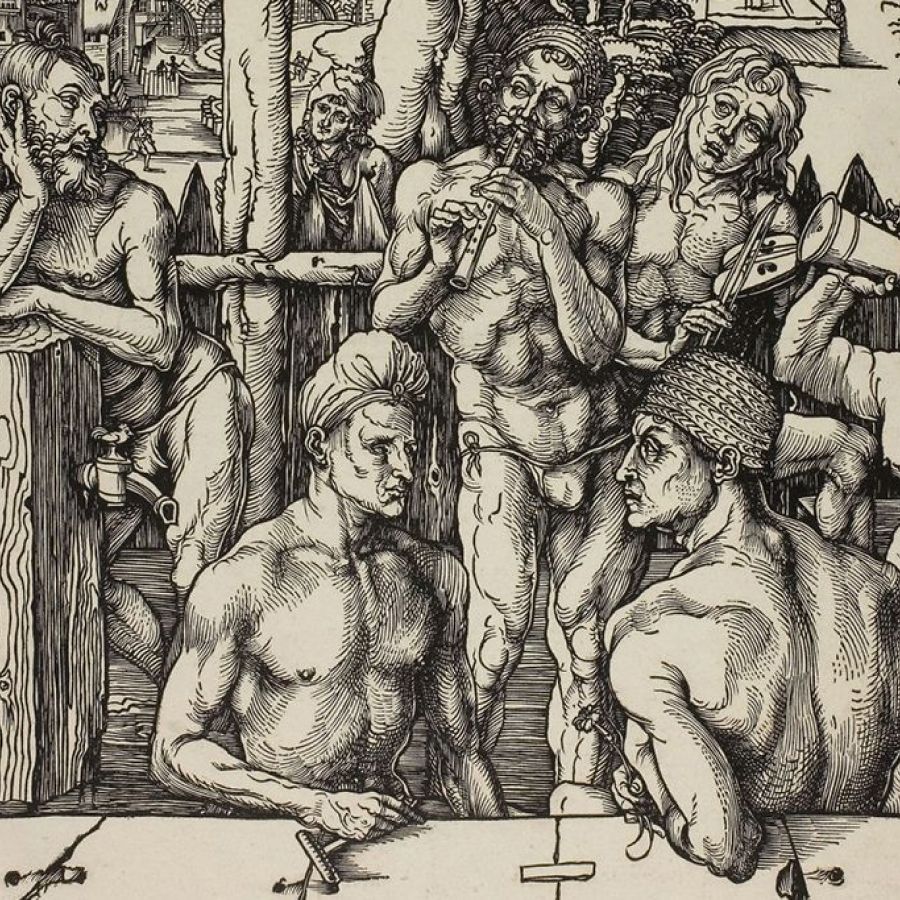
And we will wait, depressed by life in capitalism like syphilist of Albrecht Dürer depicted in the first woodcut with that motif in Western art, and we will work to bring socialism, with its universal state health care, knocking on our doors again.
Notes:
[1] Abbreviation for men who have sex with men, regardless of how they identify in the domain of sexual orientation: the emphasis is on sexual practice, not conscious self-identification.
[2] It should be noted that the suppression of the syphilis epidemic in the late 19th century through French municipal laws (whose purpose was the regulation of sexual labor by marking occasional sex workers as prostitutes) had a role in the development and strengthening of modern police forces. Cf. Kevin Henderson, "J.K. Rowling and the white supremacist history of 'biological sex'", http://slobodnifilozofski.com/2020/08/j-k-rowling-i-bjelacka-supremacisticka-historija-bioloskog-spola.html
[3] Which specifically means that the City of Belgrade, as well as other independent cultural workers, pays minimal pension and health insurance contributions.
[4] "In terms of the quality of health systems, most countries in the region are ahead of us, including Slovenia, Bulgaria, Hungary, Croatia, and Romania, while Montenegro and North Macedonia are behind Serbia, and we are at the same level as Albania." https://www.danas.rs/vesti/ekonomija/koliko-se-u-srbiji-ulaze-u-zdravstvo-a-kako-se-trosi-novac-gradjani-sve-vise-primorani-da-se-pregledaju-privatno/
The Dolphin Who Loved Me
In the 1960s, Margaret Lovatt was part of a Nasa-funded project to communicate with dolphins. Soon she was living with ‘Peter’ 24 hours a day in a converted house.
LGBT in 19th-Century Serbia
Many Turks, especially the more respected and wealthy, kept Serbian young men as lovers, so-called adžuvans or đojlens, who served for money. Even the honorable vizier had a whole bunch of them, and a special official oversaw them.
The Homosexual Role
The current conceptualization of homosexuality as a condition is a false one, resulting from ethnocentric bias. Homosexuality should be seen instead as a social role.