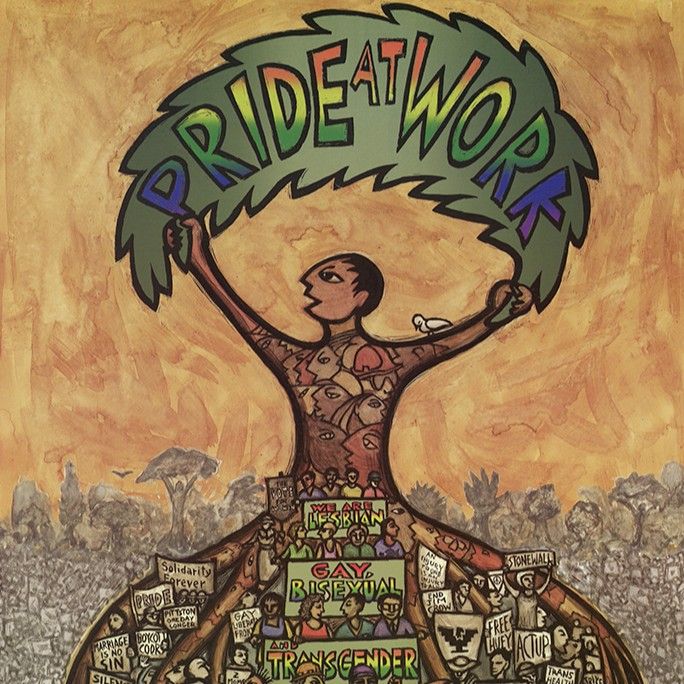
At the Crossroads of Struggles: Students, Workers, and the Queer Community
Center for Queer Studies
On October 24, 2025, at the European House in Belgrade, the Center for Queer Studies (CKS) organized a panel discussion titled “Interweaving Struggles: Workers’, Students’, and LGBT+ Solidarity in Serbia.” The discussion was moderated by Dušica Popović and Dušan Maljković, with speakers Nataša Kovačev from the United Branch Trade Unions “Nezavisnost,” Isidora Aćimov, a sociology student at the Faculty of Philosophy, and Iris from the newly formed Queer Assembly of Belgrade.
The event was supported by the Olof Palme International Center, and Maljković emphasized at the beginning that the aim was “to talk about the interweaving of struggles — about workers’ and students’ LGBT+ solidarity in Serbia, and the possibilities of re-establishing it, or establishing it perhaps for the first time.” He added that the discussion would touch upon “class issues, criticism of capitalism, trade union organizing, homophobia, transphobia, and other related topics.”
From Plenum to Assembly
The first speaker was Iris, a delegate of the Queer Assembly of Belgrade, who noted that the organization is still forming, but already shows the potential for a different model of organizing:
“The Queer Assembly is a forum for queer people in a concrete geographical space. As a forum, it allows us to develop collective positions, networking, and — one day — a concrete network of mutual support. We organize through plenums and make decisions by voting, with voluntary adherence to rules and principles of direct democracy.”
Iris also opened the question of the organization’s stance toward the European Union: “Some of our key values are anti-imperialism and anti-fascism. Some believe that participating here contradicts those values, others believe it does not, and others again see room for political opportunism.”
Responding to this, Dušica Popović presented the flag of “Queeroslavia” — the Yugoslav tricolor with a five-pointed star in rainbow colors. “The flag is an attempt to constructively reference the progressive elements of the history we inherit,” she explained. “The star is not red, because this is not about ideological uniformity, but about the continuity of cosmopolitanism and anti-provincialism.”
Global Crisis and Local Echoes
In opening remarks, Maljković provided a broader context: “According to a joint WHO and UNICEF report, around 2.5 billion people lack access to safely managed drinking water sources… The wealthiest 10 percent of people hold more than 50 percent of total wealth in nearly every country.” He concluded: “This would be the approximate picture of the global capitalist world. Let us now move to Serbia’s position within that picture, considering our semi-peripheral — or even neo-colonial — position.”
Iris followed up by pointing to the regression of liberal systems and the rise of fascism: “A regime that, until six months ago, insisted that ‘trans people are the problem’ is now turning against the entire queer population… Queer people are, once again, among the first to be targeted.”
**Systemic Change, Not Cosmetic Fixes
**
Isidora Aćimov pointed to the deeper causes of corruption and inequality:
“Corruption is not something that simply exists and can be ‘eradicated’ so that society suddenly becomes orderly. The conditions of the capitalist periphery themselves produce fertile ground for corruption.”
She emphasized the need for “systemic changes in terms of transferring power from institutions to citizens — including workers,” noting the student movement’s collaboration with self-organized workers and trade unions on amendments to the Labor Law and the Strike Law.
Nataša Kovačev from UGS “Nezavisnost” reminded the audience that “although wages have increased, we have lower purchasing power today than ten years ago.” She added that “the most vulnerable groups are young people, older workers, LGBTQ people, and Roma,” concluding: “Even where legislation is well written, it does not function in practice — practice does not follow law.”
Two Populisms and the Lost Left
On the question of populism and corruption, Iris said:
“Most of our problems are class problems… we live in a patriarchal society subordinated to various imperial forces, primarily the European Union. Economically we are most tightly connected to the EU, emigration flows into the ‘Germanosphere,’ and politically we are made compatible in ways that make exploitation easier.”
She argued that the student movement at one point “shifted to the right”: “Anti-feminism appeared, and the left was lost, replaced by populism ‘for the people’.”
Isidora Aćimov disagreed: “More intensive cooperation with trade unions began on May 1… The movement has no leaders, no figure that can be compromised — the organization itself is a major achievement.”
Kovačev added a journalist’s perspective: “I wouldn’t describe this as a struggle between two populisms. It’s true there are different ideological approaches, but the common denominator is the demands. When they are fulfilled, institutions will start doing their job — and that is the foundation of a more just society.”
**The Question of Pride and Queer Politics
**
The question of Pride and its relationship to student protests drew special attention. Maljković reminded the audience that some groups this year called “to abandon the carnival, celebratory tone — because the situation is not celebratory.”
Iris stated that “this year Pride did not meet the expectations of the queer community” and that “the queer community I represent is not particularly satisfied with the outcome.” Aćimov added that “students primarily see the Queer Assembly and similar assemblies as ‘theirs,’ not Pride and the NGO scene,” while Kovačev remarked that “the carnival atmosphere felt inappropriate this year,” and the organizers’ decision to lower the tone “was thoughtful and dignified.”
The Right as ‘National Spirit’ and Invisible Trans Women
Popović raised the question: “Why is it easier to accept students of Islamic faith from Novi Pazar than people of different gender identities?”
Iris responded: “It is easier to talk about national unity than about gender identities,” adding that “trans women were very underrepresented in the student movement.” Aćimov rejected the generalization, noting that “queer people are part of the voice — and raise their hands like everyone else when deciding what goes public.”
Kovačev later pointed to recent events: “The decision of the Studenica monastery to host students from Novi Pazar, and the Serbian Orthodox Church sending an inspection in response — is a good indicator of where we are: acts of basic human decency still surprise us.”
From Miners to Pride
In the closing part of the discussion, Maljković recalled the historical links between the workers’ movement and the LGBT movement — from Stonewall to the British group Lesbians and Gays Support the Miners. He read from the “Third World Gay Liberation Manifesto” of 1970:
“We want to abolish institutions such as the bourgeois nuclear family… Every child has the right to grow up in a non-sexist, non-racist, non-possessive atmosphere.”
Kovačev responded: “I hope we can return to that idea — not only regarding LGBTQ issues, but also the position of women, which was better in Yugoslavia than it is today in Serbia… When asked ‘what needs to be changed,’ the answer is: society.”
Education, Struggle, and Representation
In the final part of the discussion, the speakers reflected on broader social mechanisms of change. “Everything begins and ends with education,” said Kovačev. Aćimov gave an example from everyday life: “My brother-in-law (a lawyer) would ask questions like: ‘If you’re bisexual, how come you’re not attracted to your sisters?’ — and it’s easy to respond: ‘If you’re heterosexual, how come you’re not attracted to your sisters?’”
Iris emphasized visibility: “Queer (especially trans) people in Serbia are not present in public space. When you don’t have a chance to meet people from a minority, it becomes easy to demonize them. I decided to be that first step of trans representation, of trans women’s presence in Serbian public life.”
She added that “there is a narrative in Serbia that queer people are ‘NATO/EU agents,’ which is not true,” and that “many foreign organizations do not represent us.”
New Solidarity: Between Fear and Hope
In an intervention from the audience, Vladan from the Queer Assembly concluded that “the solution is not education, but struggle,” and that “Pride is no longer the reference point for queer politics.” Still, he argued that “the moment we are living through is emancipatory in an important way: we may not have ‘lesbians and miners’ in the same form, but we do have a wave that gives our struggle a particular visibility.”
When asked why worker solidarity is lacking, Kovačev answered briefly: “Because of fear for one’s livelihood.” Aćimov added: “A student supported by parents can block a university, while a worker supporting a family risks losing their job. That’s why we did not expect a general strike.”
Maljković concluded that “homophobia and transphobia do not operate only through prejudice, but also through affect — disgust, contempt, revulsion,” and that this layer “is harder to change and requires visibility, dialogue, and public presence.”
Finally, Popović suggested abandoning the term “vulnerable groups”: “We are all vulnerable. It is better to speak of the privileged and the non-privileged.”
The panel concluded with applause and the message that these issues must be addressed “outside safe houses and ghettoized spaces,” because, as was said, “every space is a space for the queer community.”
Protocol of Selective Visibility
Marking twenty-five years since the first attempt to organise a Pride Parade in Belgrade (2001–2026).
Dead Inside, But Still Horny!
An Open Discussion on Dating in the Age of Grindr, Hookup Culture, and Mental Health
Queer Studies 2026
Lecture announcements for the first semester.